Frédérique Constant, haute horlogerie laid bare
Frédérique Constant pairs two grand complications with an unprecedented dial built from seven sapphire elements.
A tourbillon and a perpetual calendar would already be enough to catch the eye of anyone who loves fine mechanics. But Frédérique Constant chose to go further. With its new Classic Tourbillon Perpetual Calendar Manufacture, the Geneva brand does more than bring together two of watchmaking’s most prestigious complications. It also reinvents the way they are staged, thanks to a striking piece of sapphire marquetry that turns the dial into a genuine window onto the movement.
On this page
- A story of complications and ambition
- Sapphire marquetry, an aesthetic complication
- The tourbillon invents a new way to read the seconds
- A perpetual calendar built to span the years
- The FC-975 calibre, true manufacture mechanics
- Classic elegance that embraces its modernity
- 88 pieces for a certain idea of haute horlogerie
- Frequently asked questions
Unveiled on 19 November 2026 and limited to just 88 pieces, this creation reflects the maturity of a manufacture that, since its founding in 1988, has never stopped championing a particular vision of fine watchmaking: ambitious, inventive and attentive to craftsmanship. That philosophy finds its full meaning here, in a watch that combines mechanical sophistication, aesthetic research and classic elegance.
A story of complications and ambition
To appreciate what makes this novelty interesting, it is worth going back a few years. Founded by Aletta and Peter Stas in 1988, Frédérique Constant gradually established itself as a house capable of designing and developing its own movements, while pursuing a pricing policy noticeably different from that of the great historic manufactures.
That ambition took shape in 2004 with the presentation of its first in-house calibre, then reached a new dimension with the arrival of a tourbillon in 2008, followed by a perpetual calendar in 2016. Two complications long reserved for a particularly wealthy clientele, which Frédérique Constant would gradually bring into its collections.
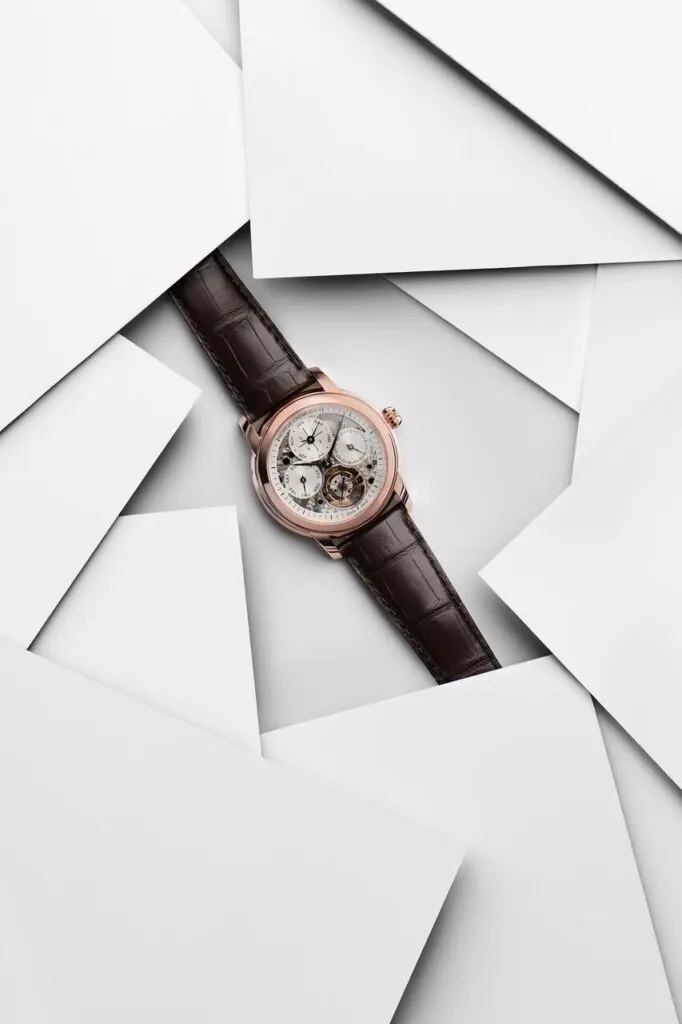
In 2018, the brand took a further step by combining these two complications in the FC-975 calibre. The following year, Passion Horlogère presented two new versions of this remarkable horological construction, housed in 42 mm cases and created to celebrate the expansion of the Plan-les-Ouates manufacture.
Seven years later, this mechanical combination has lost none of its appeal. Yet Frédérique Constant did not simply revisit a proven formula. The new Classic Tourbillon Perpetual Calendar Manufacture comes in a case reduced to 40 mm, but above all it features an entirely new dial architecture, which is arguably its most interesting evolution.
Sapphire marquetry, an aesthetic complication
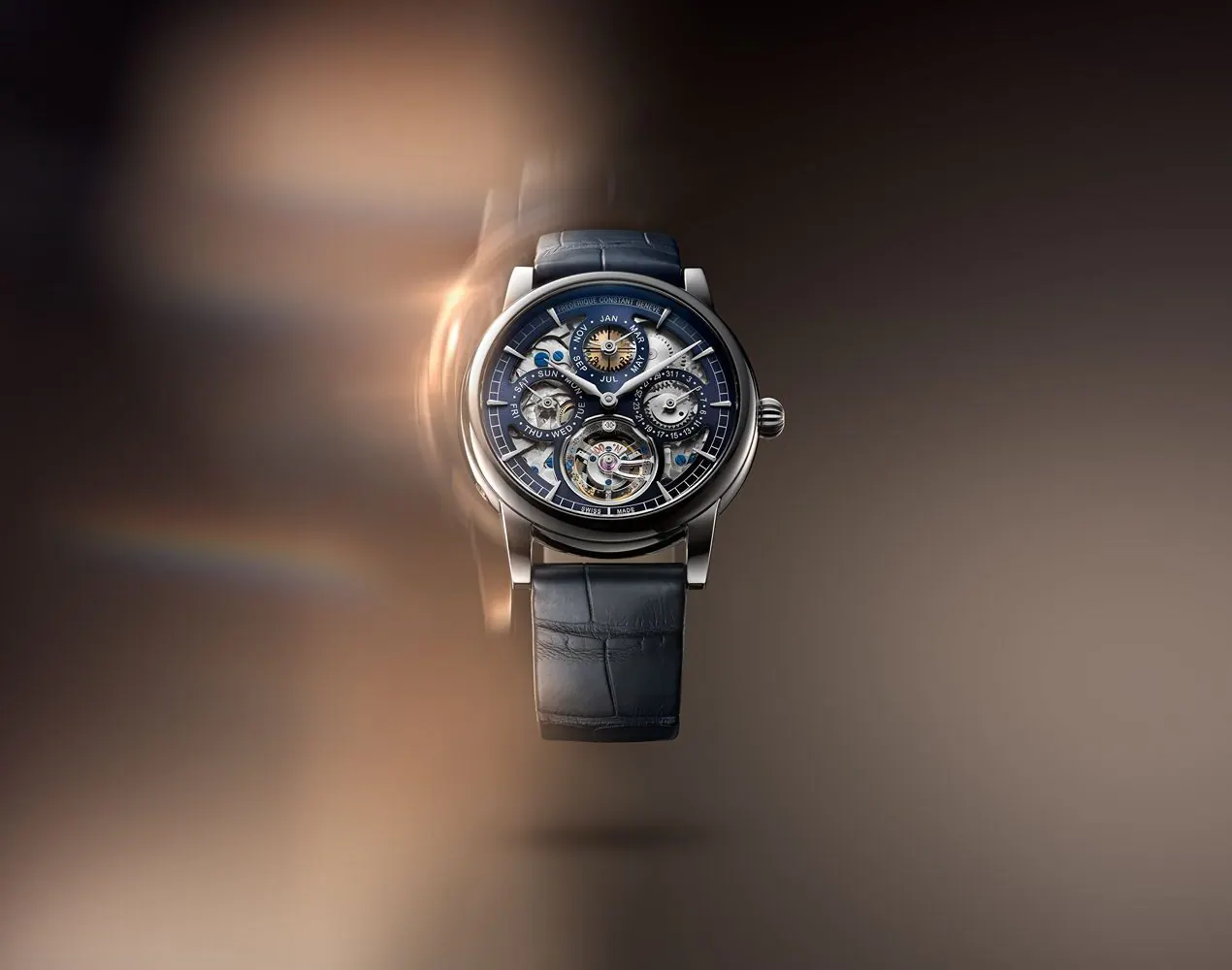
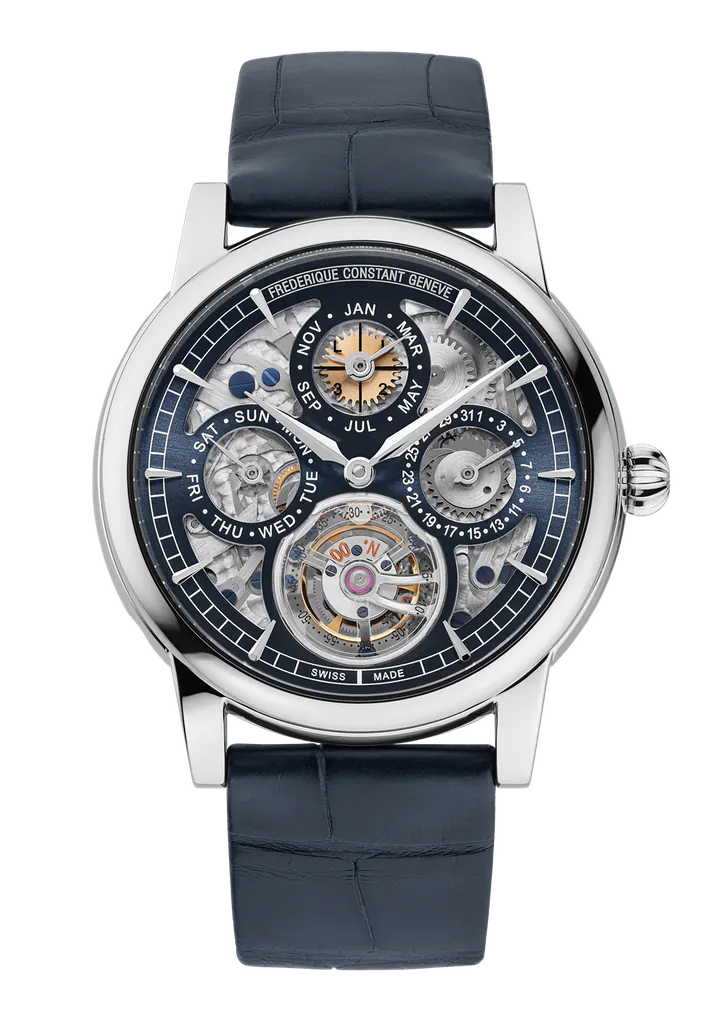
A first look at this watch reveals a composition that is both technical and remarkably harmonious. On a navy blue sunray dial, the calendar indications seem to float above a movement whose gear train is largely on view. This impression of lightness comes from an original construction. Openworked dials traditionally rely on several stacked levels, typically pairing a sapphire disc with a cut metal plate. Frédérique Constant chose to break free of this architecture by designing a true assembly of seven independent sapphire elements, precisely fitted into the dial’s openings.
Three circular surfaces dress the perpetual calendar sub-dials, while four half-moon elements complete the composition. Each one must be cut and positioned with great precision to preserve the slimness of the whole and the visual continuity of the dial.
The result is particularly interesting. Sapphire is no longer used merely as a transparent shield for the movement, but becomes a genuine aesthetic building block. Each surface reacts to light individually, creating plays of reflection that give the dial depth without compromising the legibility of the indications.
This pursuit of transparency also removes some of the layers usually required for this kind of construction. The gain is admittedly measured in tenths of a millimetre, but it contributes to the overall balance of the watch. There is an appealing kind of restraint in this approach. While some contemporary creations multiply openings to the point where reading the time becomes secondary, Frédérique Constant seems to have sought a compromise between contemplating the mechanics and the primary function of a timepiece: telling the time.
The tourbillon invents a new way to read the seconds
At 6 o’clock, the tourbillon is naturally one of the main focal points of this creation. Its cage completes a full revolution in 60 seconds, revealing the steady motion of its regulating organ. But the real novelty lies elsewhere. Frédérique Constant introduces an original indication called the « discreet second », whose principle deserves a closer look.
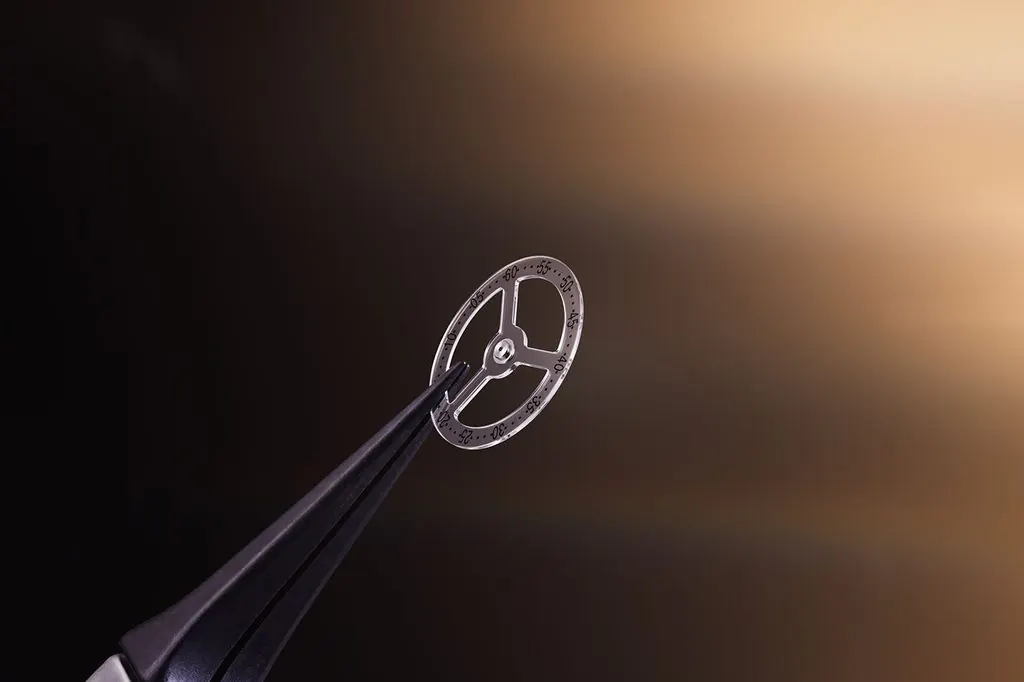
Instead of using a hand traditionally fixed to the tourbillon cage to sweep over a stationary scale, the watchmakers chose to reverse the arrangement. A transparent quartz disc, thinner than a human hair, rotates with the cage. It carries a moving scale that passes in front of a fixed marker set on the upper tourbillon bridge.
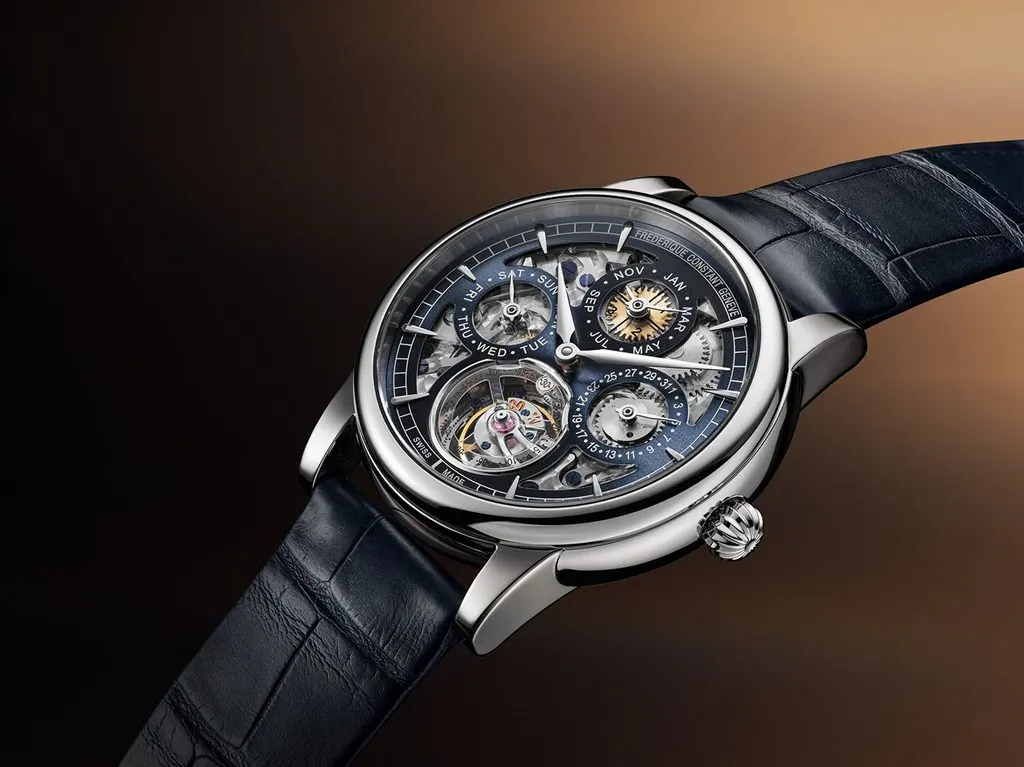
The seconds are thus read in a small gold-ringed space at the top of the aperture. The device could almost go unnoticed, so discreet is its integration. It should be stressed that this quartz disc has nothing whatsoever to do with an electronic movement. The watch remains entirely mechanical, and quartz is used here for its physical properties and its transparency.
Beyond its technical originality, this solution illustrates an interesting approach to haute horlogerie. Rather than adding yet another complication, the designers chose to renew the expression of an existing function. The tourbillon no longer simply offers the spectacle of its motion: it takes a direct part in a new way of representing the passing of time.
A perpetual calendar built to span the years
The other grand complication of this Classic Tourbillon Perpetual Calendar Manufacture is its perpetual calendar. It is a mechanism that has always held a special fascination for enthusiasts, as it shows how watchmakers can translate the irregularities of our calendar into a sequence of mechanical interactions. Unlike a simple calendar, which needs correcting at the end of months with fewer than 31 days, a perpetual calendar automatically recognises the length of each month and accounts for the leap year cycle.
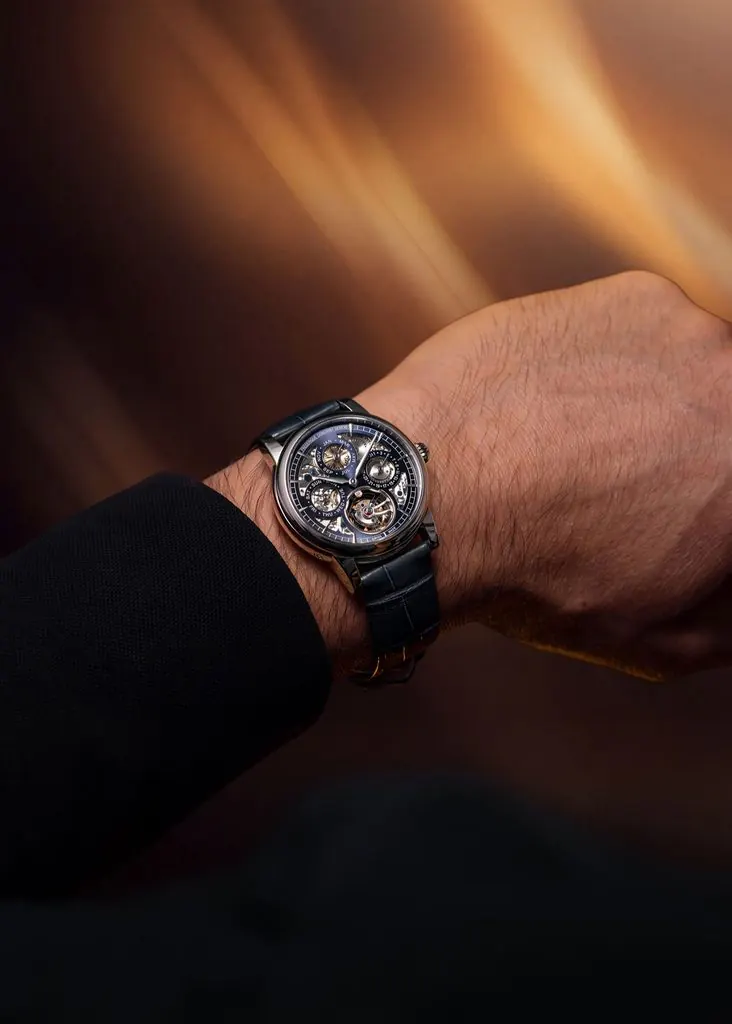
On this Frédérique Constant, the indications are laid out with welcome symmetry. The date appears at 3 o’clock and the day of the week at 9 o’clock, while the sub-dial at noon combines the month and the leap year indication. The latter distinguishes the first three years of the cycle and identifies the fourth with the letter « L », for Leap Year.
It is a classic layout, perfectly suited to the new dial architecture. The indications remain legible thanks to their dedicated hands, while the sapphire openings offer a glimpse of mechanics whose complexity contrasts with the apparent simplicity of the display. The word « perpetual » does, however, call for a clarification. Like most traditional perpetual calendars, this mechanism will need a correction in the year 2100, which will not be a leap year under the rules of the Gregorian calendar. A deadline distant enough for several generations of owners to enjoy this remarkable complication.
The FC-975 calibre, true manufacture mechanics
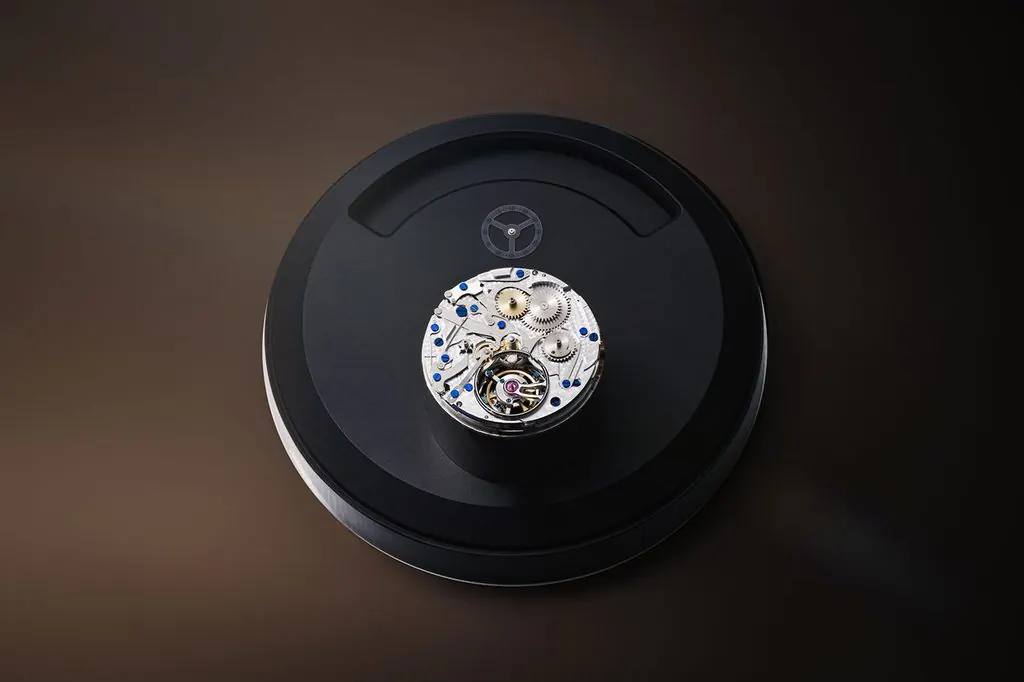
At the heart of this creation lies the automatic FC-975 calibre, developed and assembled in Frédérique Constant’s Geneva manufacture. Combining a tourbillon and a perpetual calendar, this movement beats at 28,800 vibrations per hour, or 4 Hz. It has 33 jewels and a power reserve of 38 hours.
This autonomy remains relatively modest by today’s standards, especially for a watch with a perpetual calendar, a complication that naturally prefers to keep running to avoid tedious resetting. Still, this technical choice is a reminder that the quest for an ever longer power reserve is not necessarily a priority when the aim is to preserve the architecture of a particularly complex movement.
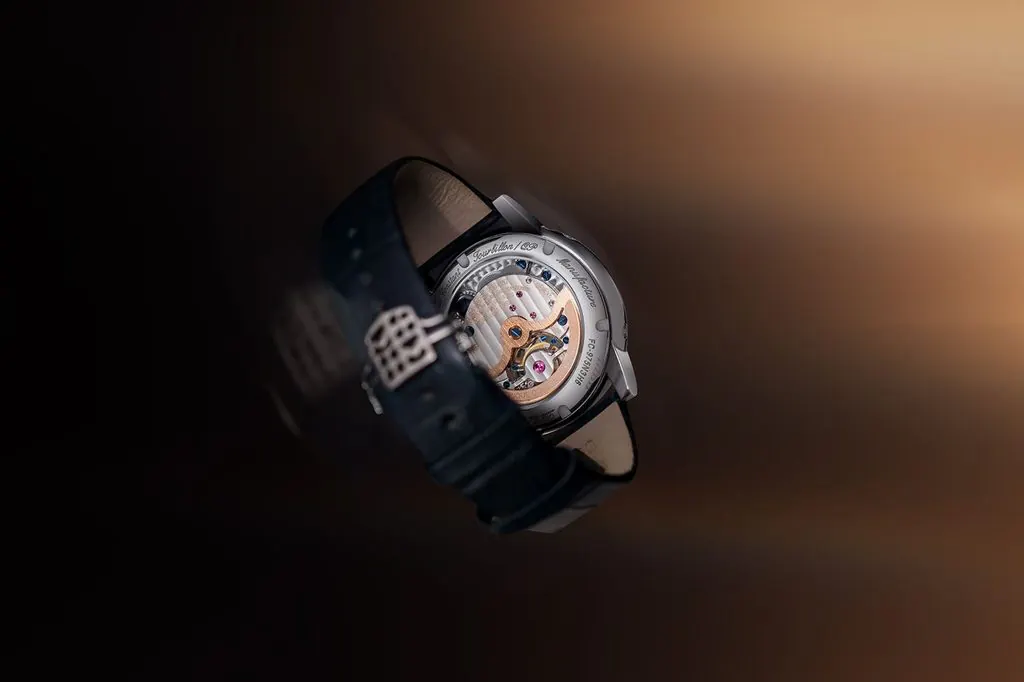
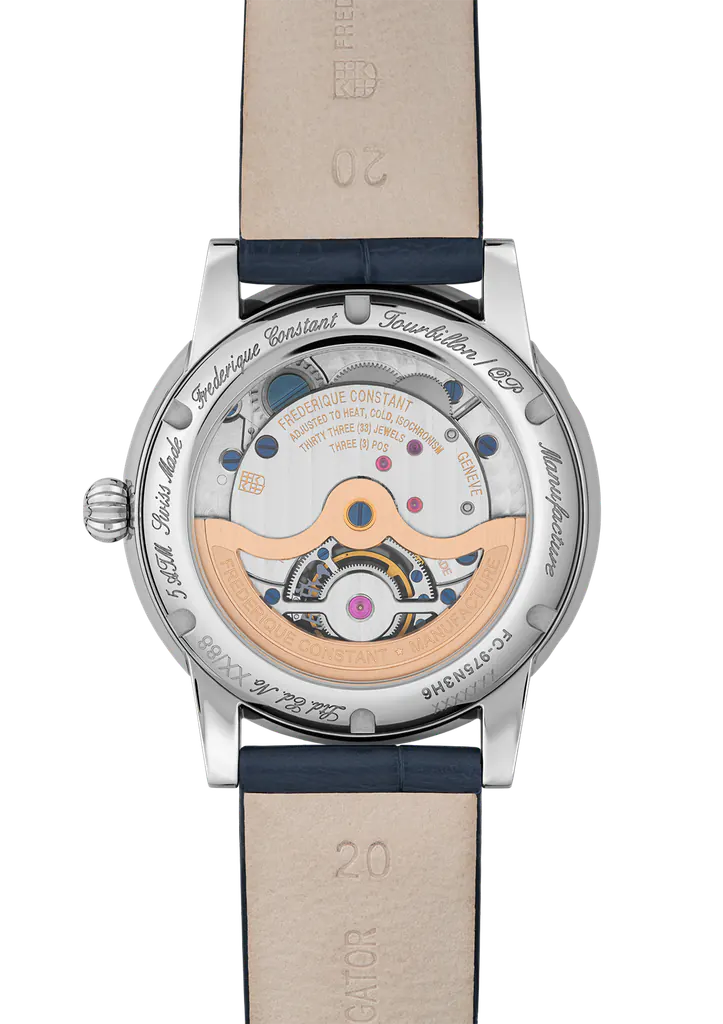
The quality of execution also deserves attention. The bridges and mainplate are decorated with perlage, while vertical Côtes de Genève highlight the surfaces of the movement. The oscillating weight, with a rose gold coloured galvanic treatment, adds a touch of warmth to an ensemble largely dominated by metallic tones.
A transparent caseback naturally allows these finishes to be admired from the movement side, while the dial openings offer another reading from the front. This dual perspective is genuinely appealing. It reveals a mechanism one usually has more opportunity to admire in technical photographs than in a watch designed to be worn every day.
Classic elegance that embraces its modernity
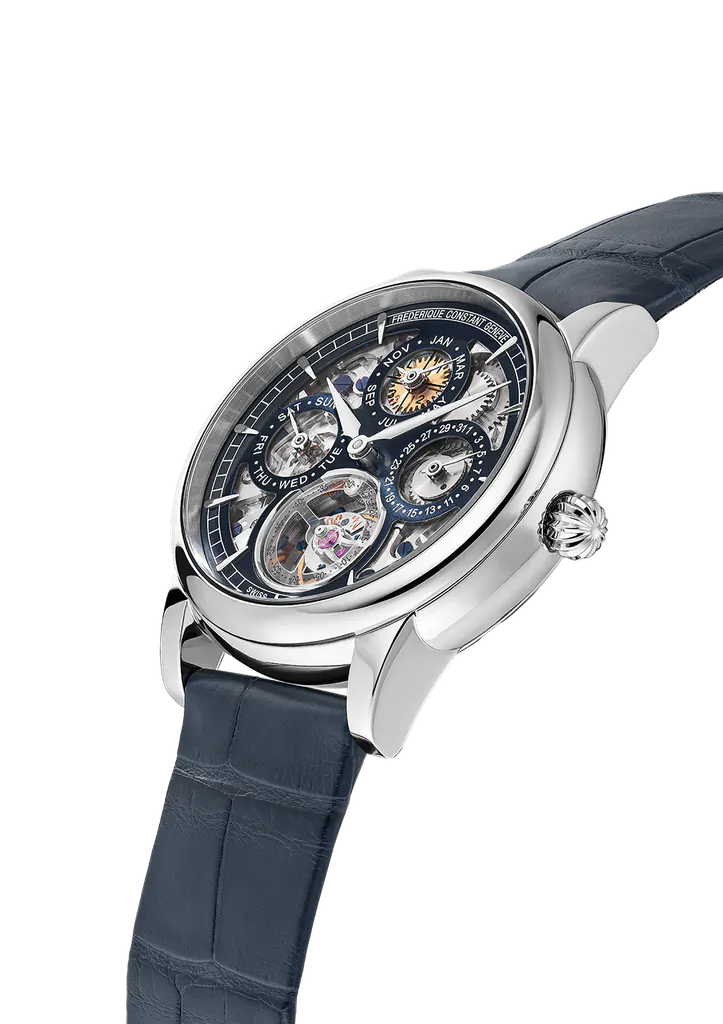
To house this mechanical ensemble, Frédérique Constant opted for a polished stainless steel case measuring 40 mm in diameter and 12.69 mm thick. That is two millimetres smaller than the first 42 mm classic versions, which makes for more contemporary proportions and potentially greater versatility on the wrist. The case nonetheless retains a definite presence, the logical consequence of the mechanical architecture it holds.
The watch is protected by a domed sapphire crystal with anti-reflective treatment. It is water resistant to 5 ATM, or 50 metres, a specification consistent with its role as a dress watch rather than a sports watch.
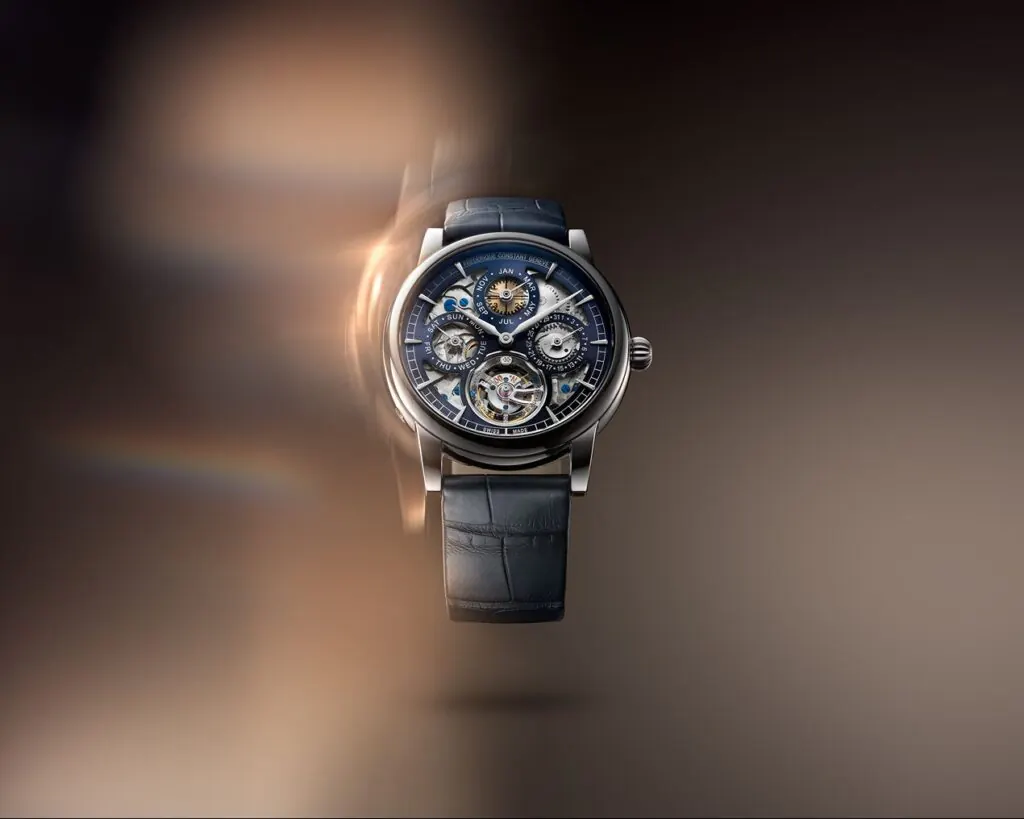
The diamond-cut, rhodium-plated applied indexes echo the polished hands in a quest for understated elegance. The navy blue dial extends into an alligator strap in the same shade, made using a rembordé technique and fitted with a folding clasp. The whole shows real coherence. Despite a highly visible tourbillon and a perpetual calendar, the watch keeps the aesthetic codes of a classic piece. A way of recalling that sophistication does not necessarily call for ostentatious display.
88 pieces for a certain idea of haute horlogerie
The Classic Tourbillon Perpetual Calendar Manufacture, reference FC-975N3H6, will be produced in just 88 pieces, a number that refers directly to the year Frédérique Constant was founded, 1988. Each watch is individually numbered, with the engraving on both the tourbillon cage and the caseback. A detail that underlines the special nature of this edition and its position at the top of the manufacture’s creations.
Its retail price is announced at 26,995 euros. An obviously considerable sum in absolute terms, but one that should be put in the context of contemporary haute horlogerie. Few manufactures offer, at this price level, the combination of a tourbillon and a perpetual calendar within an in-house movement.
This is precisely the ground on which Frédérique Constant has built part of its identity. For nearly four decades, the brand has strived to make certain expressions of fine watchmaking more accessible, without giving up on technical research or the pleasure that carefully executed mechanics can bring.
With this new Classic Tourbillon Perpetual Calendar Manufacture, it also shows that innovation is not limited to inventing new mechanisms. It can stem from a different way of designing a dial, of exploiting the properties of a material, or of rethinking an indication as fundamental as the seconds. And perhaps that is where the true appeal of this watch lies. Behind its two grand complications and its sapphire marquetry dial, it expresses a conviction dear to Passion Horlogère: fine watchmaking is above all a matter of know-how, mechanical intelligence and passion. A passion that, fortunately, continues to inspire those who imagine the watches of tomorrow.
Frequently asked questions
Its retail price is announced at 26,995 euros. Reference FC-975N3H6 is produced in 88 numbered pieces, a figure that refers to 1988, the year the brand was founded.
The automatic in-house FC-975 calibre, which combines a tourbillon and a perpetual calendar. It beats at 28,800 vibrations per hour (4 Hz), has 33 jewels and offers a 38-hour power reserve.
Instead of stacking a sapphire disc on an openworked metal plate, Frédérique Constant assembles seven independent sapphire elements fitted into the dial openings: three circular surfaces for the perpetual calendar sub-dials and four half-moon elements.
A transparent quartz disc, thinner than a hair, rotates with the tourbillon cage. Its moving scale passes in front of a fixed marker on the upper bridge, and the seconds are read in a small gold-ringed space. The watch remains entirely mechanical.
The polished stainless steel case measures 40 mm in diameter and 12.69 mm thick, two millimetres smaller than the 42 mm versions. It is fitted with a domed anti-reflective sapphire crystal and is water resistant to 5 ATM (50 metres).