

Some pilot’s watches borrow the aesthetic codes of aviation. And then there are watches that seek to reconnect with the original purpose of aeronautical watchmaking: genuinely assisting the pilot during a specific phase of flight. With the Startimer Pilot Chronograph Automatic IFR, Alpina and Watch Angels move firmly into that second territory. That of a mechanical tool watch, conceived not as a nod to the cockpit, but as a real instrument that helps the pilot make sense of an aeronautical procedure.

Presented as a world first, this creation born of the collaboration between Watch Angels and Alpina introduces a fully mechanical horological function that makes it possible to visualise the entry paths into an IFR holding pattern, in other words within the framework of instrument flight. This phase, particularly demanding during the approach, calls for rigour, precision and rapid analysis.

The watch obviously does not claim to replace onboard instruments. Nor does it seek to stand in for the certified systems fitted to modern aircraft. What it offers is a mechanical, self-contained and immediate reading of a procedure familiar to every IFR pilot: entering a holding pattern via a direct, parallel or teardrop entry.
On this page
- Aviation credentials that did not come out of nowhere
- Watch Angels, a laboratory of mechanical ideas
- IFR: a complex procedure, a mechanical reading
- A complication in the case, not in the movement
- A Startimer, first and foremost
- Legibility, teaching and use
- Redundancy, safety and mechanical autonomy
- A new path for the mechanical pilot’s watch?
- Technical specifications
- Frequently asked questions
Aviation credentials that did not come out of nowhere
To understand this Startimer Pilot Chronograph Automatic IFR, it is worth remembering first that the relationship between Alpina and aviation is no recent opportunism. The Geneva-based house lays claim to a long history with pilot instruments, from its first chronographs of the 1920s and 1930s to the military aviation watches of the 1940s, by way of various collaborations in the aeronautical world. The Startimer Pilot collection was relaunched in 2003 to reconnect with that heritage, after the brand was taken over by Aletta and Peter Stas.

Speaking to Passion Horlogère, Oliver Van Lanschot Hubrecht, Brand Director of Alpina, stresses this continuity. In his view, Alpina is one of the pioneers of aviation watchmaking, with a history going back to the first decades of the 20th century. Precision, legibility, robustness and reliability have remained at the heart of its approach.

Yet this new Startimer also marks a step up. Oliver Van Lanschot Hubrecht explains that in recent years, Alpina’s pilot’s watches had mainly evolved in terms of their aesthetic codes. With this IFR version, the house returns to what has always been its strength: designing genuine instruments built to meet the needs of pilots.
The wording matters. This is no longer simply a watch “inspired” by the world of aviation. It is a watch that transposes an essential instrument flight procedure to the wrist, in an entirely mechanical way. For Alpina, the piece therefore represents both a natural continuation of its history and a major evolution of the Startimer collection.
Watch Angels, a laboratory of mechanical ideas
Alongside Alpina, Watch Angels brings a complementary approach. Founded in 2019 and based in Arogno, Switzerland, the company describes itself as a watchmaking platform, a community of collectors and a research and development laboratory dedicated to innovation in timekeeping, all at once. Its philosophy is to put usefulness and meaning back at the heart of the watch, developing projects in collaboration with brands, engineers and specialists.

For Guido Benedini, CEO of Watch Angels, the ambition was clear from the outset: not to create a watch that merely borrows the codes of aviation, but to imagine a genuine instrument capable of meeting a pilot’s concrete need. The question asked at the start of the project was a simple one: what mechanical function can still be truly useful to a pilot today?

It is this question that gives the project its interest. The complication was not born of a desire for gratuitous technical showmanship. It grew out of a search for real-world use. Guido Benedini sums up the spirit of the approach this way: for the first time in this context, mechanical watchmaking becomes a tool that supports the pilot during a concrete phase of the flight.

The partnership between Alpina and Watch Angels was therefore built around a shared goal: the desire to go beyond a mere aesthetic reinterpretation of an aviation heritage. After talking with pilots, Watch Angels turned its attention to IFR procedures, and more specifically to holding pattern entry. This procedure follows a clear geometric logic: a relationship between an inbound course, the pattern’s orientation and three possible types of entry. A logic structured enough to be translated into mechanics.
IFR: a complex procedure, a mechanical reading
In aviation, two flight regimes are generally distinguished. VFR, for Visual Flight Rules, refers to flying by sight. IFR, for Instrument Flight Rules, refers to flying by instruments. It comes into play when visibility is degraded or when the flight environment becomes more complex: major airports, dense traffic, international flights, passenger transport. The Alpina press release points out that IFR flight is a fundamental building block of professional pilot training.
One of the most demanding phases of IFR flight is the approach. The aircraft has to integrate into the environment of the destination airport, taking into account infrastructure, traffic and published procedures. When several aircraft arrive at the same time, it may be necessary to enter a racetrack-shaped waiting circuit, known as a holding pattern, in order to sequence traffic before landing.

It is precisely this phase that the Startimer Pilot Chronograph Automatic IFR sets out to support. The pilot needs to know the aircraft’s current heading, as well as the inbound course to the holding fix. From this data, the pilot must determine whether to enter the holding pattern with a direct, a parallel or a teardrop entry. Each pattern can also be flown with right-hand turns, as a standard pattern, or with left-hand turns, as a non-standard pattern.

The watch’s principle rests on this mental mechanism. Using its bidirectional bezel, the pilot enters two pieces of information: the course required to reach the holding fix, then the current heading. The watch then shows the type of entry to fly, the headings to follow and the direction of entry. All of this through a colour code: orange for the direct entry, red for the offset teardrop entry, blue for the parallel entry.

The infographic supplied by Alpina and Watch Angels sums up this logic in three steps: set the inbound course, set the heading, then read the result. It also details the role of the 360° outer bezel, the rotating flange, the standard and non-standard windows, the UTC hand and the chronograph function.
A complication in the case, not in the movement
One of the most interesting aspects of this watch lies in its architecture. The IFR function is entirely mechanical, yet it does not alter the movement. It is integrated into the watch’s external parts, mainly the bezel and the flange. The press release states that the calculation and display system is housed in the 44.5 mm ceramic bezel and in the flange, around a 43 mm case water-resistant to 10 ATM.

Guido Benedini puts it very clearly: the intelligence of this complication lies around the movement rather than inside it. Watch Angels therefore worked on the interaction between the case components, the flange, the bezel and the display, so as to make an aeronautical procedure legible without touching the watch’s engine.
This approach is particularly interesting because it is a reminder that watchmaking innovation is not necessarily confined to the calibre. A watch can also innovate through its interface, its external architecture, and the way it brings mechanics, information and use into dialogue. In this case, the IFR complication is as much a display complication as a complication of understanding.

The Swiss Made AL-570 automatic movement drives the hours, minutes, seconds, the run indicator, the chronograph and the UTC function. The brand quotes a 62-hour power reserve, a frequency of 28,800 vibrations per hour and 25 jewels.
A Startimer, first and foremost
The technical dimension could have overwhelmed the design. It does not. Oliver Van Lanschot Hubrecht insists on one essential point: beyond the complication, this watch had to remain “a beautiful Alpina”, instantly recognisable as a Startimer Pilot.
The watch features a sunray blue dial, a silver outer ring, a black minute track, polished and luminescent applied Arabic numerals, black hands filled with luminescent material, a 12-hour counter at 6 o’clock, a 15-minute counter at 12 o’clock, a run indicator at 9 o’clock and a central UTC function.

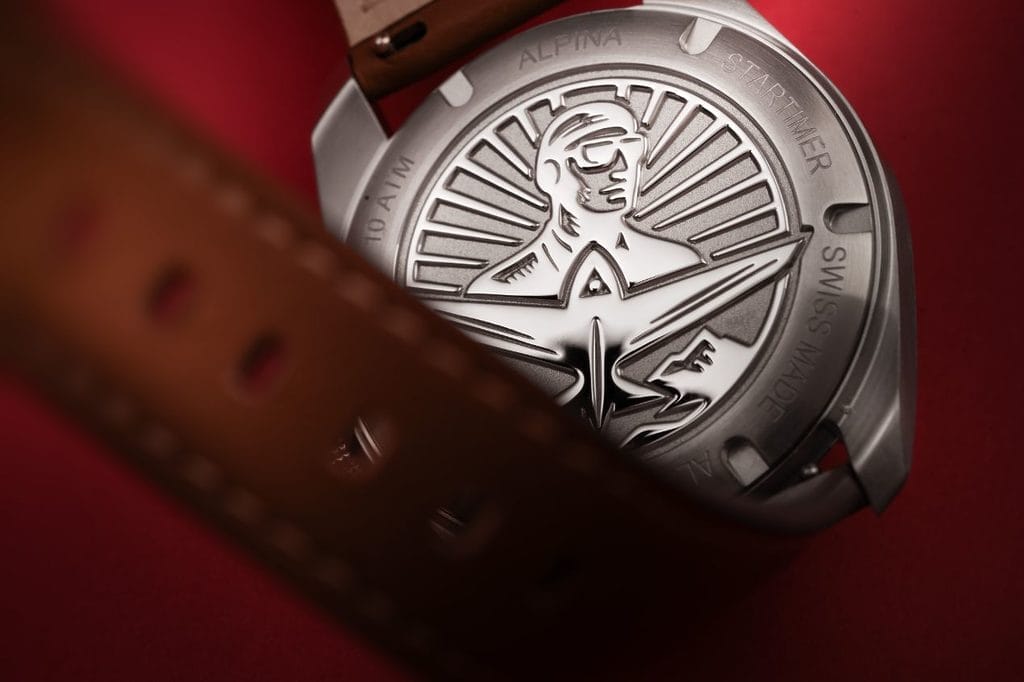
The three-part steel case is fitted with a 44.5 mm bidirectional bezel in matt black ceramic. The case middle and lugs feature vertical satin finishing, while the bevels are mirror-polished. The engraved caseback reproduces the holding pattern entry diagrams, extending the watch’s teaching logic all the way to its reverse side.
The overall result has a strong personality. There is a great deal of information on the dial, but that density is consistent with the purpose of the object. A pilot’s watch was never designed for graphic emptiness. Its first job is to inform. Here, the challenge was to make a wealth of data legible without sacrificing the aesthetic identity of the Startimer collection.
Legibility, teaching and use
For Guido Benedini, the biggest challenge was not only mechanical precision. That was essential, of course. But the two major issues were legibility and ease of use. In an aviation environment, a function only makes sense if it can be used quickly, simply and without ambiguity.
This remark is central. The whole promise of the Startimer Pilot Chronograph Automatic IFR rests on a simple equation: two pieces of information in, one immediate reading out. Behind that gesture, the geometric and mechanical complexity has to disappear. The pilot does not need to admire the complication for it to be useful. The pilot needs to be able to read it.

This requirement also explains the educational effort surrounding the watch. Oliver Van Lanschot Hubrecht acknowledges that this complication may seem technical to the general public. But, like many watch complications, its appeal goes beyond everyday use. It tells a story, expresses know-how and brings an aesthetic and exclusive dimension to the watch. Alpina has therefore developed various educational materials to make the technology understandable without oversimplifying it.

This is probably where the watch can reach a wider audience than professional pilots alone. Aviation enthusiasts will see in it a mechanical embodiment of a real procedure. Watch lovers will find an unusual complication. Collectors will see a piece limited to 300 units, at the crossroads of the tool watch, the teaching instrument and the singular horological object.
Redundancy, safety and mechanical autonomy
In aviation, the notion of redundancy is essential. Systems complement, cross-check and safeguard one another. The Startimer Pilot Chronograph Automatic IFR fits into that mindset. It replaces nothing. It confirms, supports, gives tangible form.

Oliver Van Lanschot Hubrecht explains that the watch is intended as a flight companion that complements the onboard instruments. In certain situations, such as holding pattern entry procedures, it allows the pilot to work out the calculation mentally and then get immediate mechanical confirmation. This combination of reliability, simplicity and independence reinforces its role as a backup tool and a trusted companion in the cockpit.

This idea is important because it avoids a misunderstanding. The watch does not claim to do better than a modern cockpit. It simply reminds us that a self-contained mechanical instrument can still be relevant when it is designed around a real need. That may be precisely what makes the project so interesting: this is not nostalgia for the aviation of old, but an attempt to bring the pilot’s watch up to date with contemporary aviation.
A new path for the mechanical pilot’s watch?
The question raised by this Startimer therefore goes beyond the scope of a limited edition. For a long time, pilot’s watches innovated because pilots had concrete needs that a watch could meet. Then onboard electronics took over, and the pilot’s watch often became an object of heritage, style or memory.

Guido Benedini sees this creation as opening up a new path. In his view, the question now is whether modern aviation still contains procedures, calculations or information that mechanics can interpret in a relevant and useful way. The mechanical watch could then remain not only a beautiful object, but also a self-contained backup instrument, always available on the wrist.

With this Startimer Pilot Chronograph Automatic IFR, Alpina and Watch Angels offer a concrete answer to that question. The watch does not try to compete with avionics. Nor does it claim to return to an era when the wrist was one of the pilot’s few points of reference. It offers something else: a supplementary mechanism, intelligent and legible, designed to give shape to a procedure.


That is precisely what sets this piece apart in today’s pilot’s watch landscape. It is not content with displaying large numerals, a UTC hand, a generous crown or a cockpit aesthetic. It attempts to give the mechanical aviation watch a function again. And in a sector where many new releases sometimes limit themselves to revisiting proven codes, that deserves a closer look.
Technical specifications
Model: Watch Angels x Alpina Startimer Pilot Chronograph Automatic IFR
Reference: AL-570NW4S46
Limited edition: 300 pieces
Case: three-part stainless steel
Diameter: 43 mm
Thickness: 15.9 mm
Bezel: bidirectional, matt black ceramic, 44.5 mm
Crystal: domed sapphire with anti-reflective coating
Water resistance: 10 bar
Dial: sunray blue, polished and luminescent applied Arabic numerals
Functions: hours, minutes, seconds, run indicator, chronograph, UTC, IFR function
Movement: Swiss Made AL-570 automatic chronograph
Power reserve: 62 hours
Frequency: 28,800 vibrations per hour
Strap: smooth grey leather with steel pin buckle, additional brown leather strap, quick-change system
Recommended retail price: €4,295

With the Startimer Pilot Chronograph Automatic IFR, Alpina and Watch Angels deliver a rare proposition: a contemporary pilot’s watch that does not merely evoke aviation, but seeks to engage with one of its real procedures. Its appeal lies not only in its technical complexity, nor in its status as a world first. Above all, it lies in its intent.

This watch raises a fascinating question: what can mechanical watchmaking still contribute in a world dominated by electronics, screens and onboard systems? Alpina and Watch Angels answer in a few words: a self-contained, legible, redundant tool, designed with and for pilots, yet evocative enough to appeal to watch and aviation enthusiasts alike.
A pilot’s watch, at last, that does not only look to the past. It is gaining altitude again.
Frequently asked questions
A pilot’s watch born of a collaboration between Alpina and Watch Angels, presented as a world first: a fully mechanical function that helps visualise holding pattern entry in instrument flight (IFR). It is limited to 300 pieces.
Using the bidirectional bezel, the pilot sets the inbound course, then the current heading. The watch then shows the type of holding pattern entry through a colour code: orange for the direct entry, red for the teardrop entry, blue for the parallel entry, with windows for standard and non-standard patterns.
No. The system is housed in the external parts, the 44.5 mm ceramic bezel and the flange, around the movement. The Swiss Made AL-570 automatic chronograph calibre drives the hours, minutes, seconds, chronograph, UTC function and run indicator, with a 62-hour power reserve and a frequency of 28,800 vibrations per hour.
A three-part stainless steel case measuring 43 mm in diameter and 15.9 mm thick, with a 44.5 mm matt black ceramic bezel, a domed sapphire crystal with anti-reflective coating and water resistance to 10 bar. The caseback is engraved with holding pattern entry diagrams.
Its recommended retail price is €4,295. Reference AL-570NW4S46, it comes on a grey leather strap with a second brown leather strap and a quick-change system.

Leave a Reply