

Introduction
This chronograph by the Chronographe Suisse brand was passed down to my father by his own father. Neither the box nor the papers are in his possession.
Some research carried out on my part seems to indicate a timepiece from the late 1930s to the early 1940s, fitted with a Landeron movement.
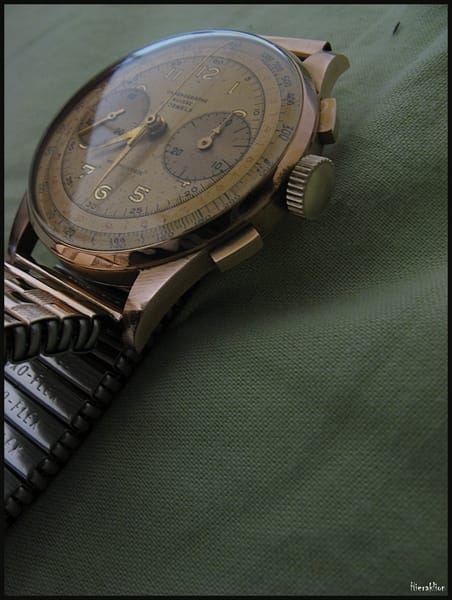
The case is in 18k rose gold, 750/1000th. Its diameter is 37mm, which at the time was considered a standard size. The bracelet is not the original bracelet. It must have been added by my grandfather.
On this page
Overview
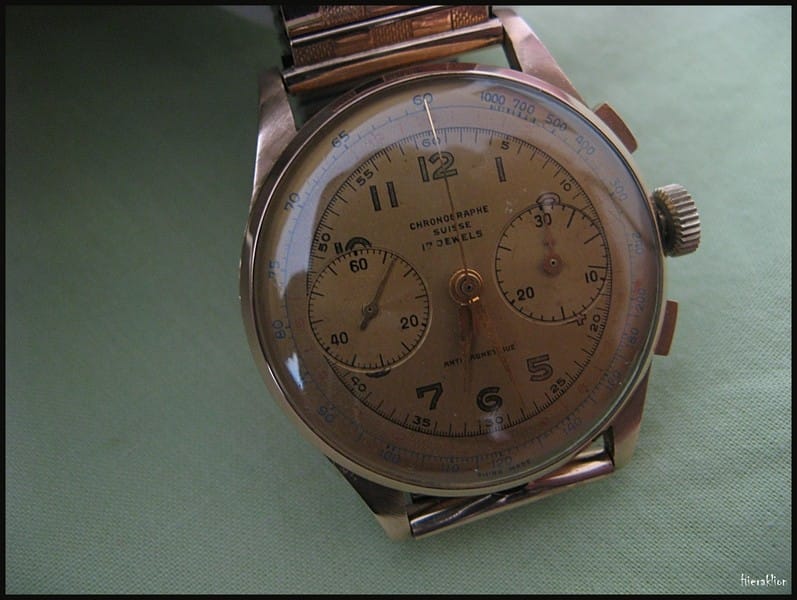
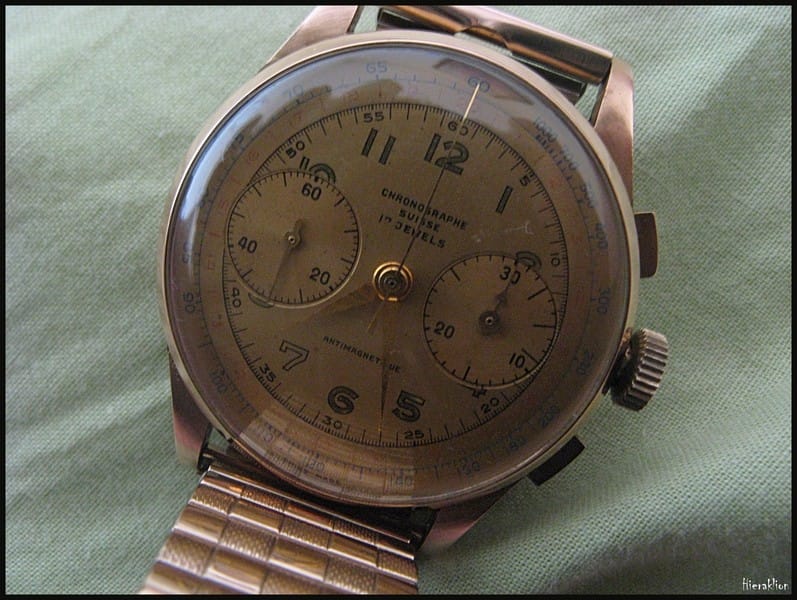
These images allow you to appreciate the fairly deep colour of the case’s rose gold as well as the coordinated colour of the dial. The middle case is brushed but the bezel and the case back are polished. No idea whether this is the original finishing, since my research seems to indicate differences.


The hallmarks
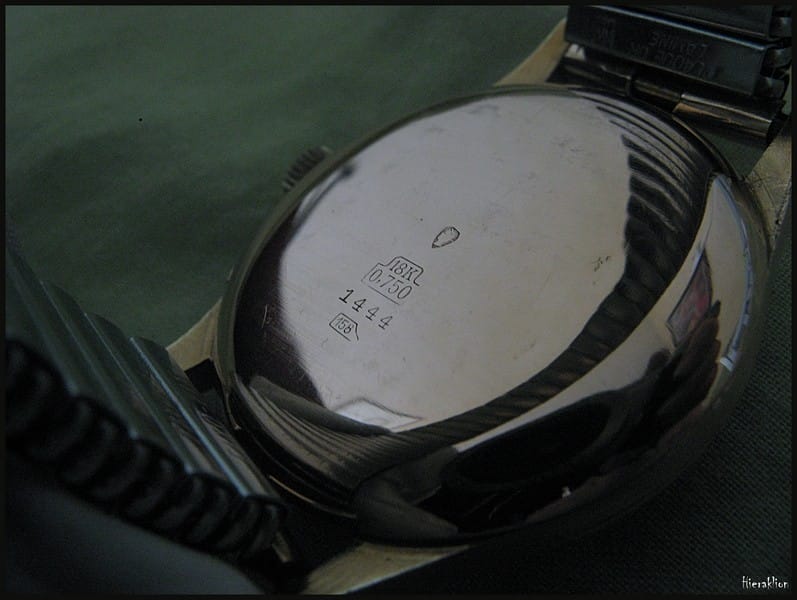
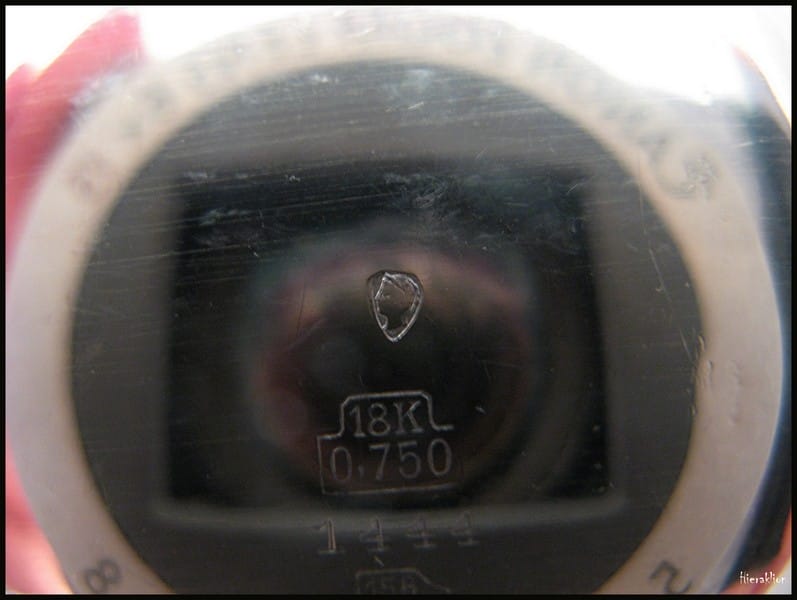
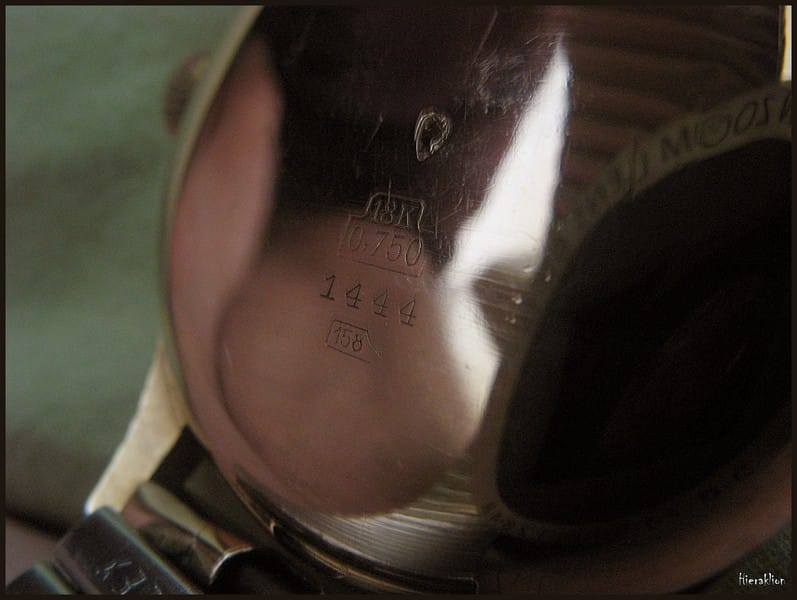
On the case back of the watch you can find the following various hallmarks (from top to bottom):

the official Swiss Helvetia hallmark (woman’s head) attesting both to its Swiss origin and to the percentage of gold in the metal (in France this is referred to as a guarantee hallmark). This hallmark was used from the federal law of 20/06/1933 on the control of trade in precious metals and articles made of precious metals (precious metals control act, LCMP) until 1995, when it was replaced by a Saint Bernard head. The letter placed beneath the head (not visible here) represented the town of the assay office (G for Geneva, C for La Chaux-de-Fonds, for example).
– the fineness hallmark indicating the percentage of gold in the metal (the fineness), here the watch is hallmarked 18 carats (750/1000). 18-carat gold (18k) represents 18 g of gold for a total mass of 24 g. 18 : 24 = 0.750, i.e. 750/1000 th .
– the watch number, here it is the 1444 th watch of this type ever manufactured.
– the individual or collective responsibility mark of the manufacturer (called the maker’s hallmark in France), here the number 158. This hallmark, registered with the country’s administration (Switzerland in our case), indicates who made the watch and vouches for its fineness.

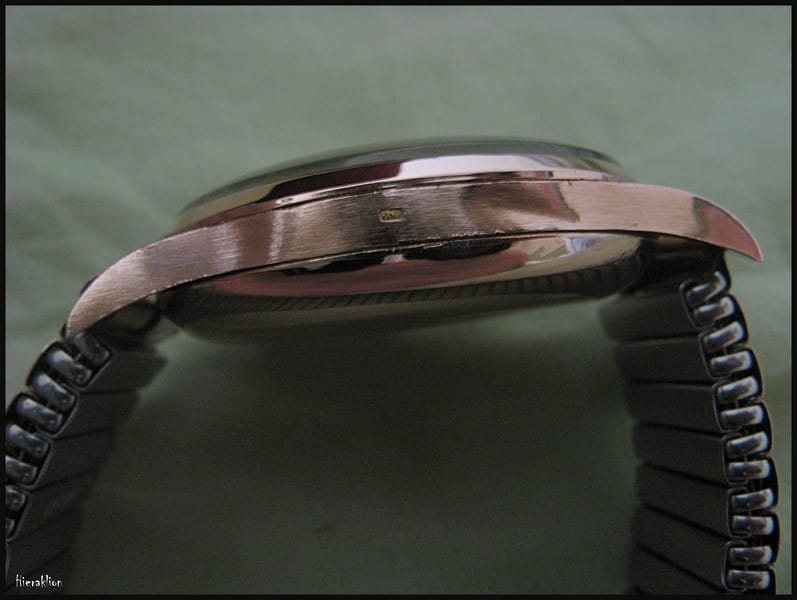
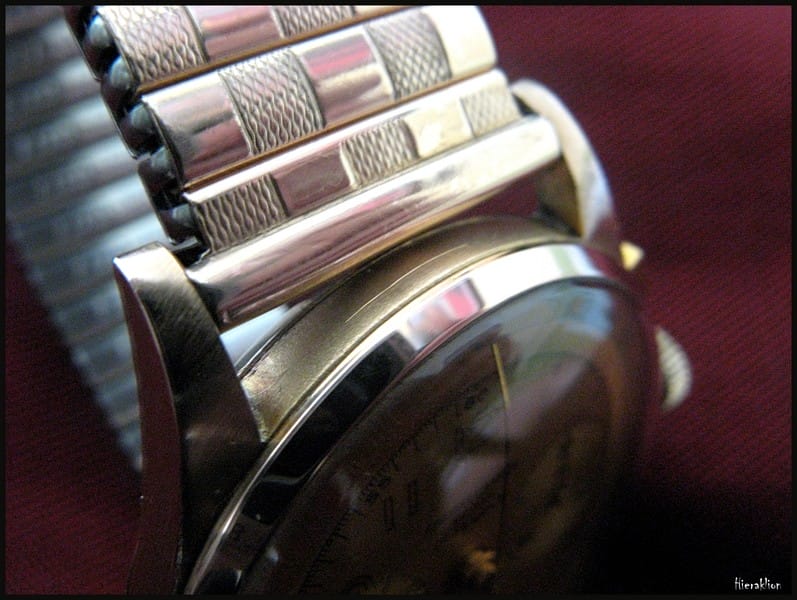
Profile view of the middle case, the bezel and the lugs Profile view of the middle case, the bezel and the lugs Profile view of the middle case, the bezel and the lugs
There is a hallmark on the left-hand side of the middle case. I have not been able to decipher it, but one might think it could represent a weevil.
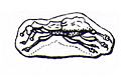
This hallmark was applicable to articles imported into France from countries whose products were subject in France to the same regime as similar French products.
The middle case is brushed. The case back and the bezel, on the other hand, are polished.
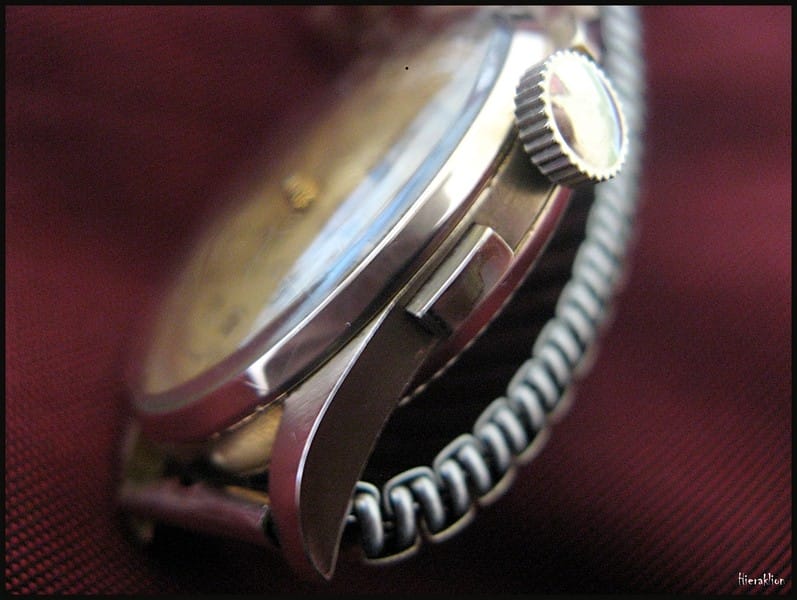
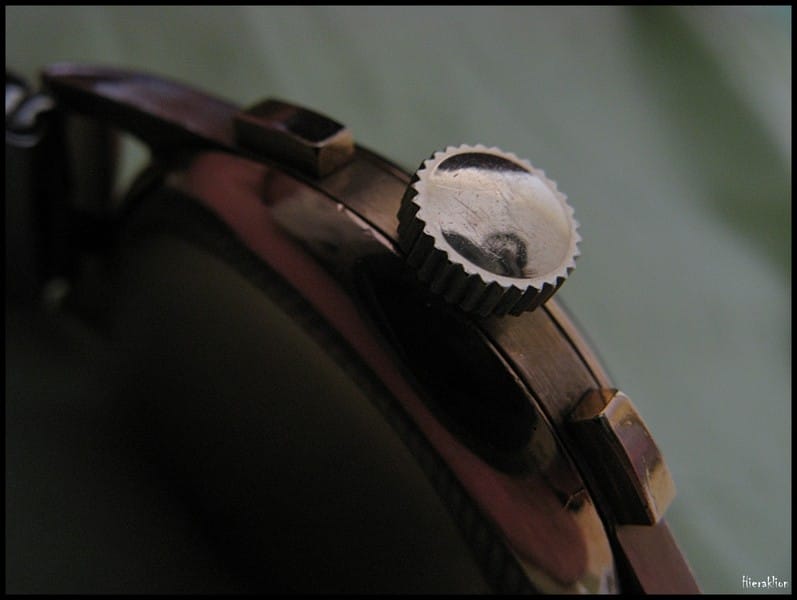
The crown and the chronograph pushers
The crown is not a screw-down crown. The pushers are rectangular. The one at 10 o’clock starts the chronograph function. The second pusher at 4 o’clock, for its part, stops the chronograph function and resets the chronograph hand to the 12 o’clock position.

The bracelet
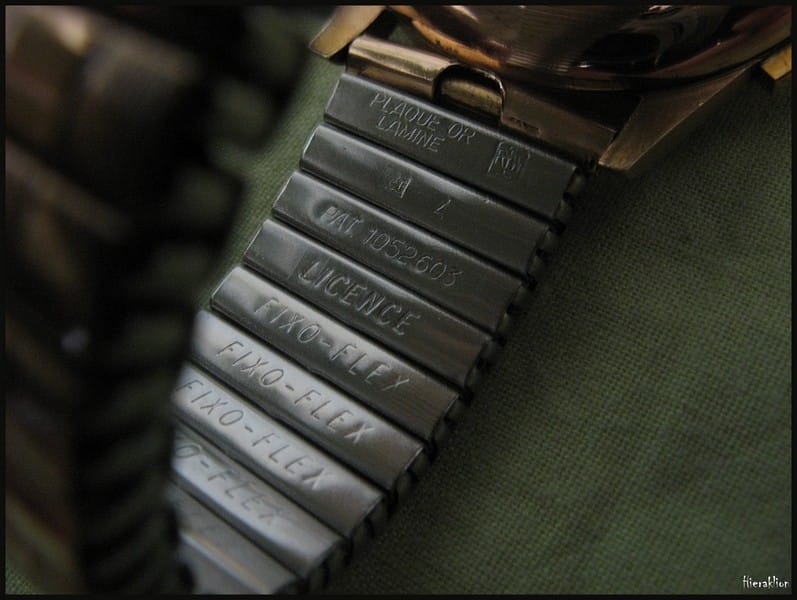
The bracelet, which is not original, is in rolled yellow gold plate. The term rolled means that the bracelet is made of a lower base metal (most likely stainless steel in this case) to the surface of which a gold plate has been welded or brazed by heat.
Technically speaking, in order to qualify as rolled gold plate:
– the gold layer must have a minimum fineness of 10K
– this quality of gold must correspond to less than 1/20 of the gross weight of the article.
It is a Fixo-Flex type bracelet that was very fashionable in the 1970s… and particularly effective for waxing your wrists!
The dial
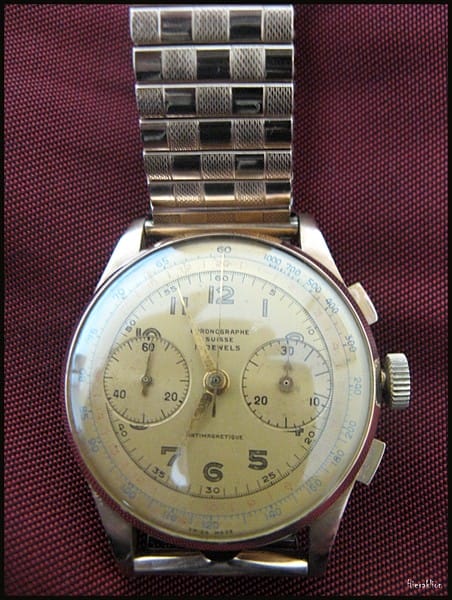
Hours, minutes (central), seconds at 9 o’clock, central chronograph hand often called the sweep seconds hand (at 12 o’clock in our case)
– Chronograph with minute counter
Graduation for reading the observation duration to 1/5 of a second (innermost graduation),
Measurement of the duration of an observation up to 30 minutes via the sub-dial at 3 o’clock.
– Measurement of the duration of a telephone conversation
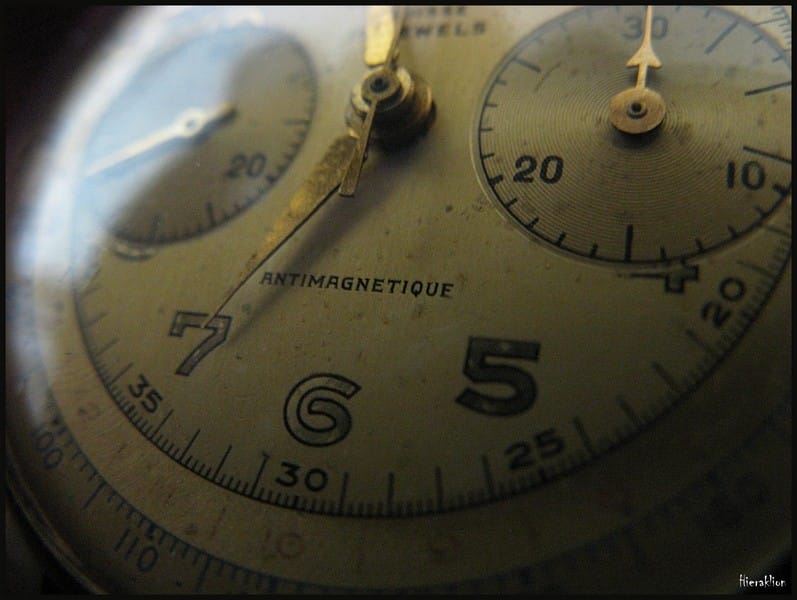
At the time, telephone charges were generally calculated on a conversation duration of 3 minutes. This is why the chronograph minute counter at 3 o’clock has special “longer” divisions to indicate the 3rd, 6th and 9th minute.
– Telemeter scale (middle graduation, red in colour)
The telemeter allows you to measure the distance separating the observer from a phenomenon that is first visible, then audible. I’ll leave it to you to visit the page that very nicely describes the use of the telemeter:
http://www.horlogerie-suisse.com/journal-suisse-horlogerie/technique/cadran-chronographe-042008.html
– Tachymeter scale (outermost graduation, blue in colour)
It is graduated in such a way as to make it possible to measure fast speeds. I’ll leave it to you to visit the following page that very nicely describes the use of the tachymeter:
http://www.horlogerie-suisse.com/journal-suisse-horlogerie/technique/cadran-chronographe-042008.html
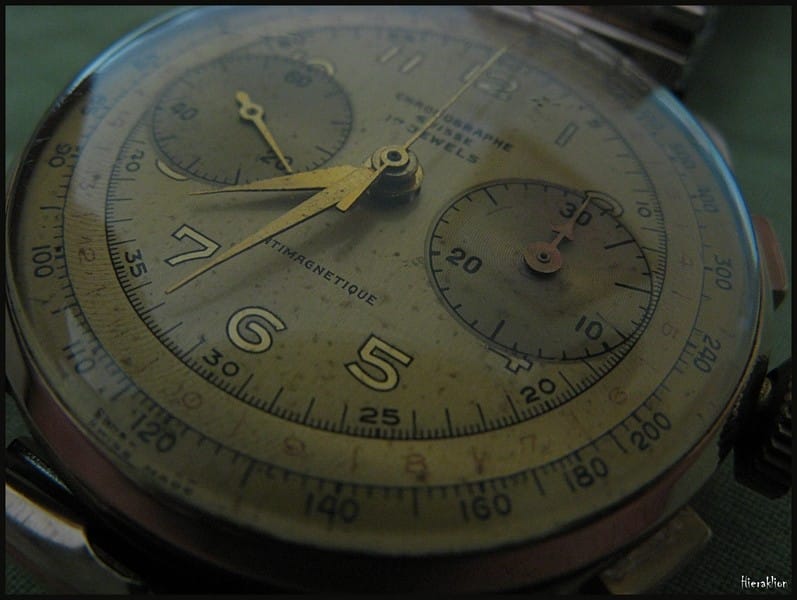
The dial is a little pitted. It has clearly never been restored. You can notice the 3 colours of the dial, the lighter zone for the divisions of the telemeter scale in red, the darker part of the sub-dials at 3 and 9 o’clock. The central zone where the numerals are located and the outermost zone comprising the divisions of the tachymeter scale are between these first 2 tones.
The indexes and numerals
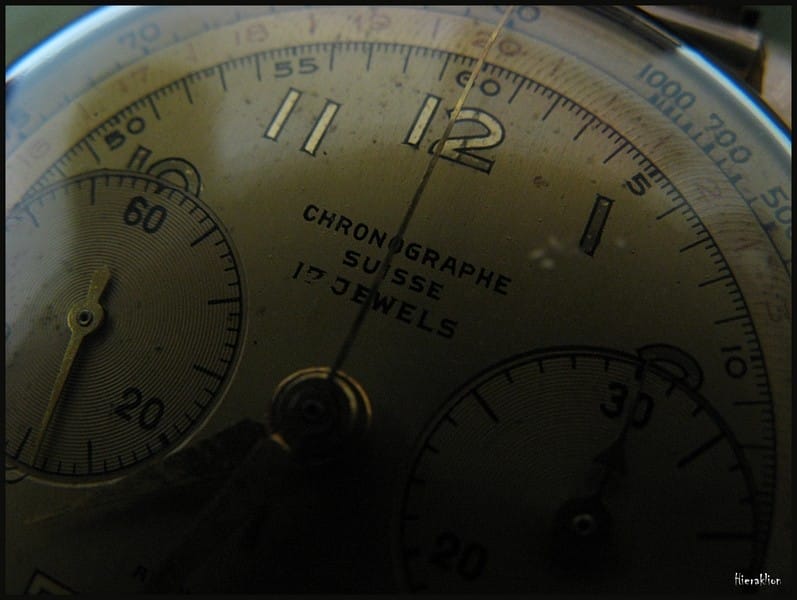
The hour numerals are particularly bright even now and appear to be painted in gold.


The hands
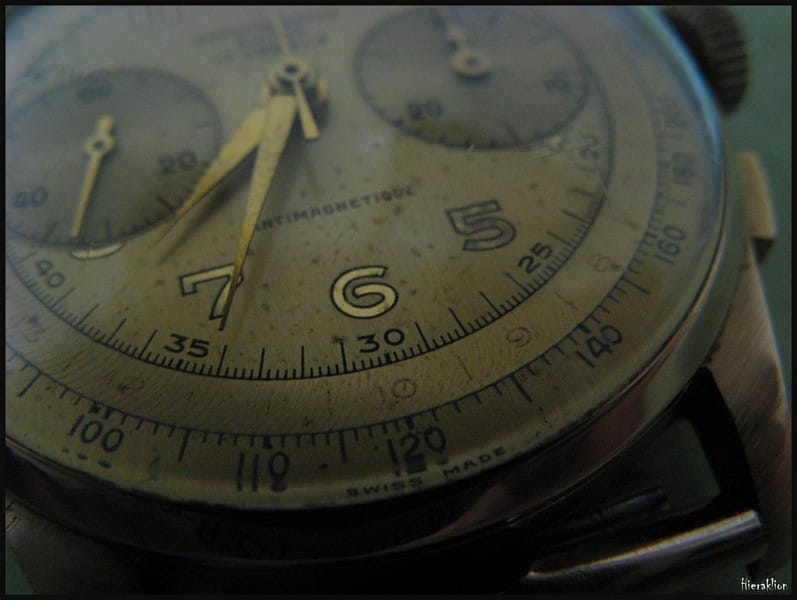
All the hands appear to be gold. The chronograph seconds hand is curved at its tip so as to follow the shape of the crystal.
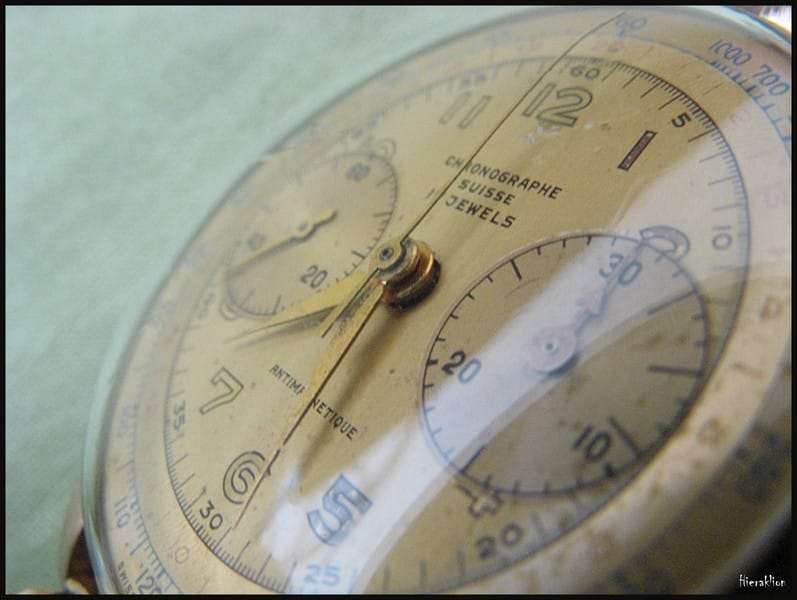
The divisions in detail
A few photographs with the details of the various divisions.
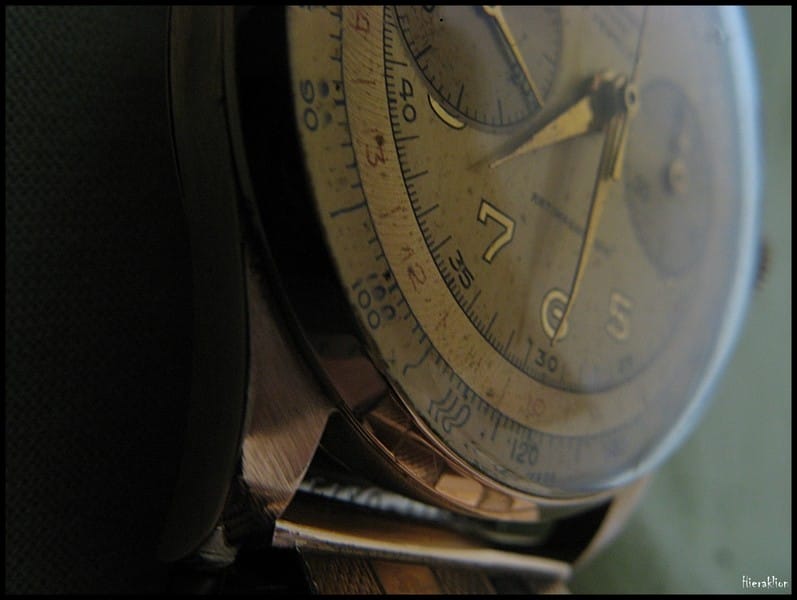

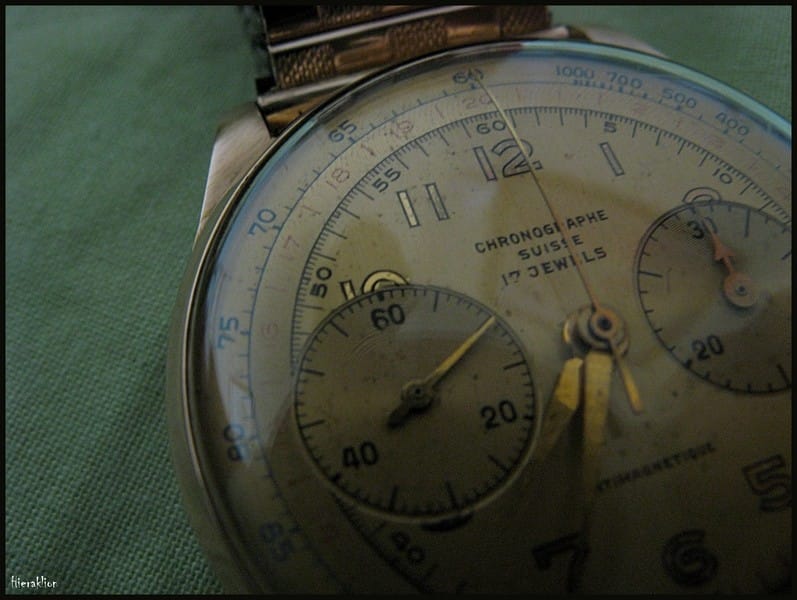
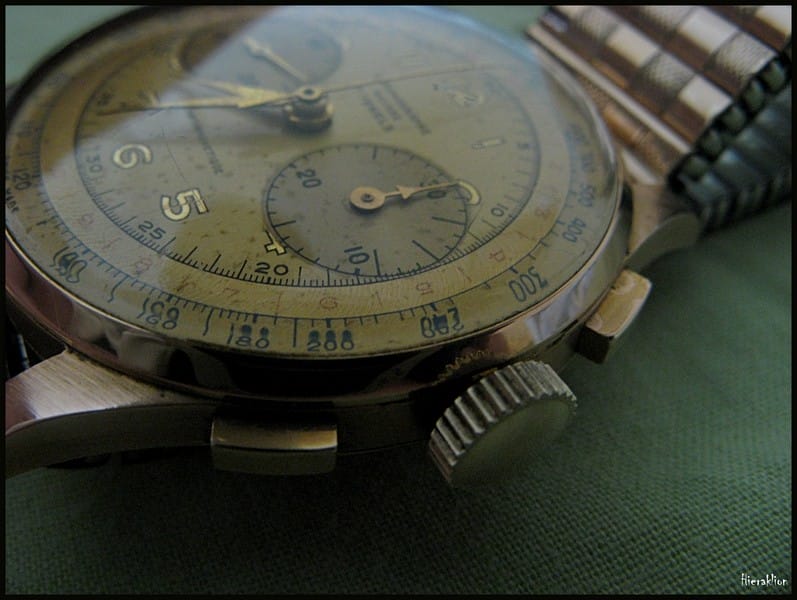
You can particularly see on this photograph the divisions for calculating the measurement of the duration of a telephone conversation.
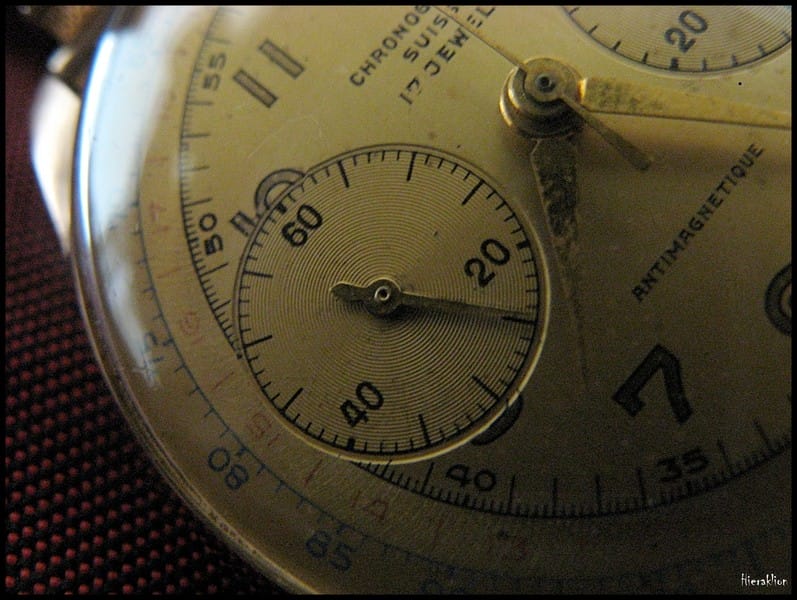
The guilloché of the sub-dials
The seconds sub-dial at 9 o’clock and the minute sub-dial at 3 o’clock have a guilloché finish. There is no other guilloché on the dial.
The case back
The case back is snap-on. Engraved on its inner face are 3 notations indicating that the watch has been either repaired or opened at least 3 times.
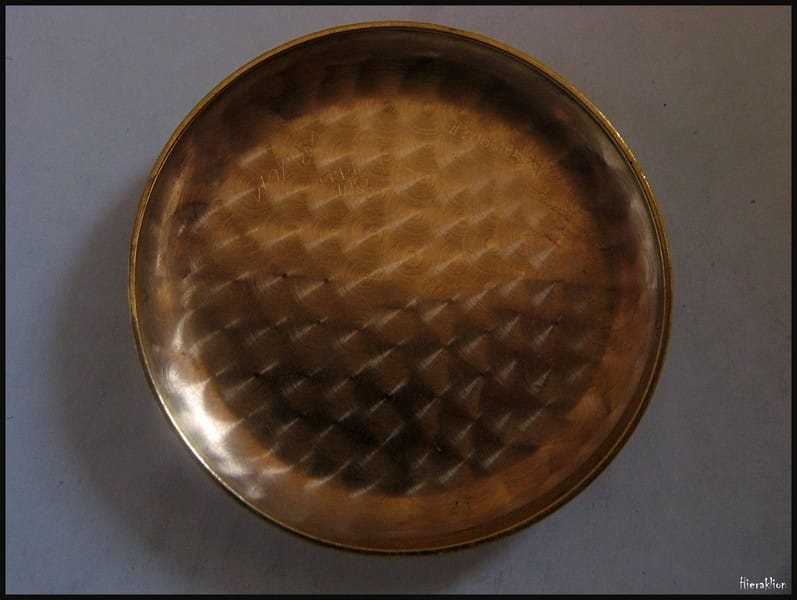
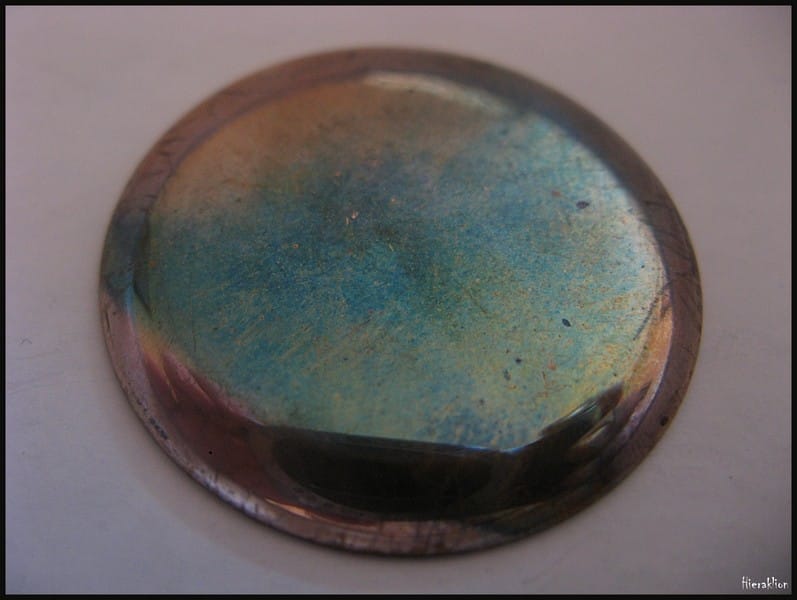
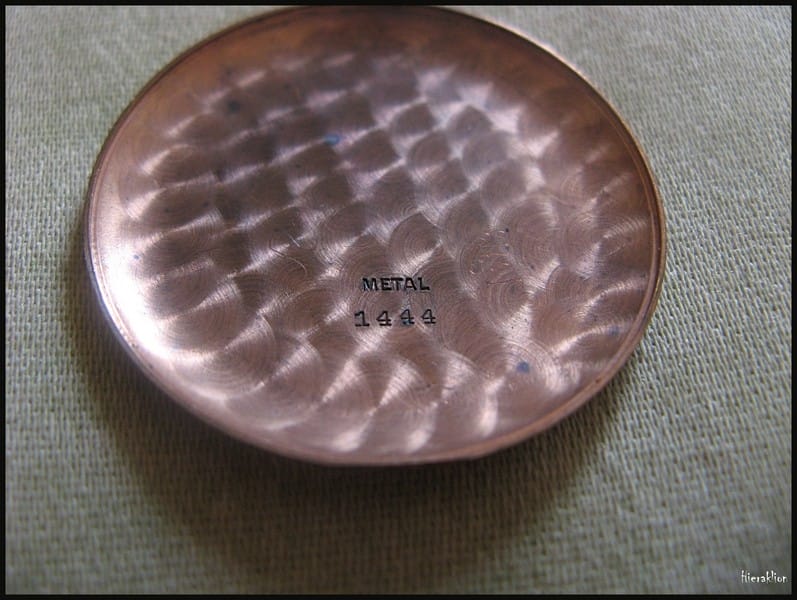
The next element, the inner case back, protects the movement. Its inner face repeats the watch’s serial number (1444).
The movement
The movement is a Landeron 48. This family was produced from 1937 to 1970 in around 3,500,000 units, all variants included. The characteristics of the Landeron 48 are:
- Lignes: 13.75 ‘ ‘ ‘, Dia.= 31mm
- Height= 6.2mm
- 17 jewels
- Frequency = 18000 vph
- Power reserve: 42h
- Manual winding
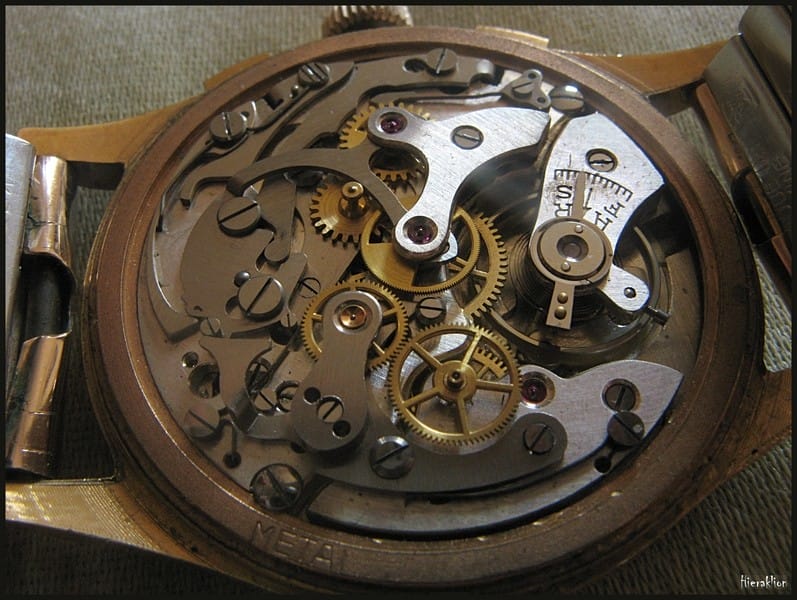
The Landeron 48 is a chronograph mechanism integrated into the movement with a cam (below, 2 photographs of the entire movement).
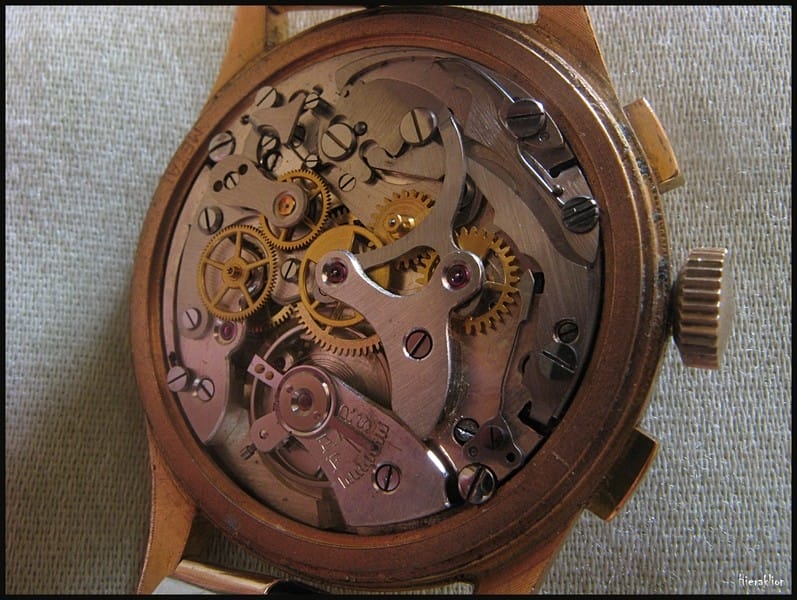
Movement details

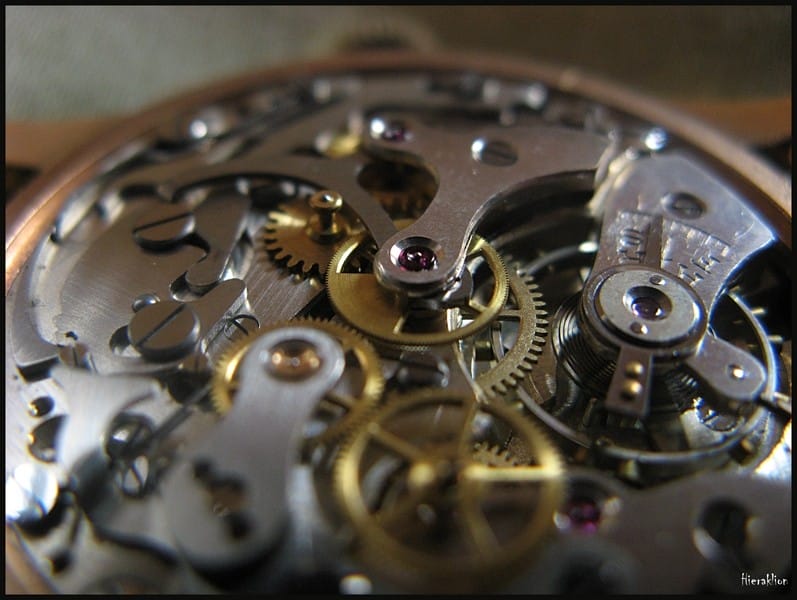
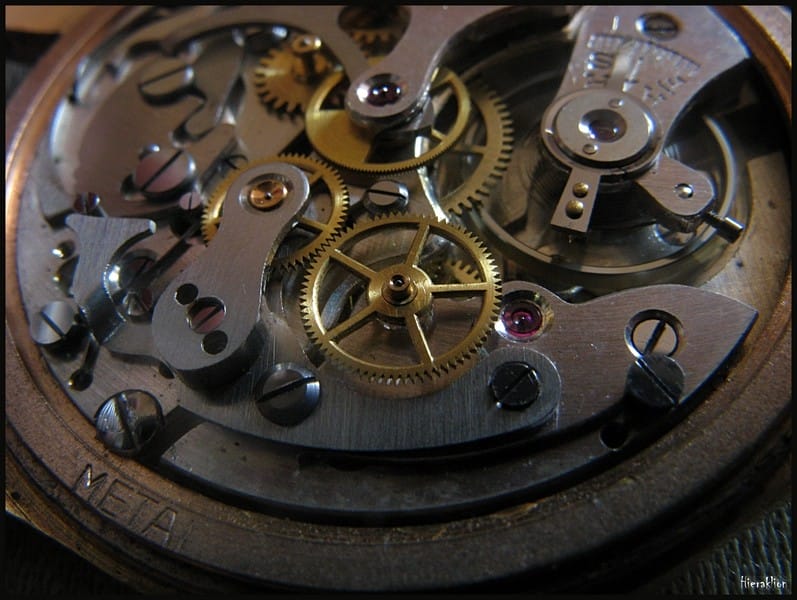
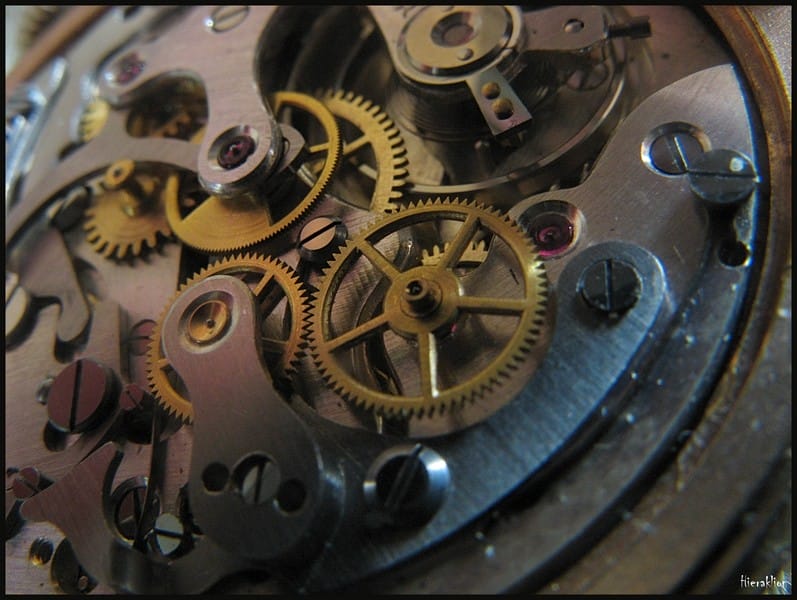
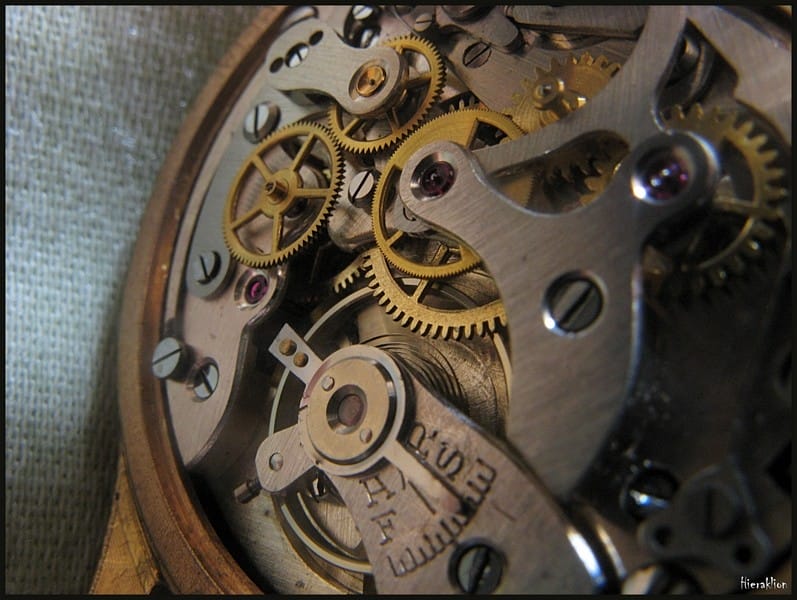

2 photographs, finally, giving an idea of the thickness of the various parts.
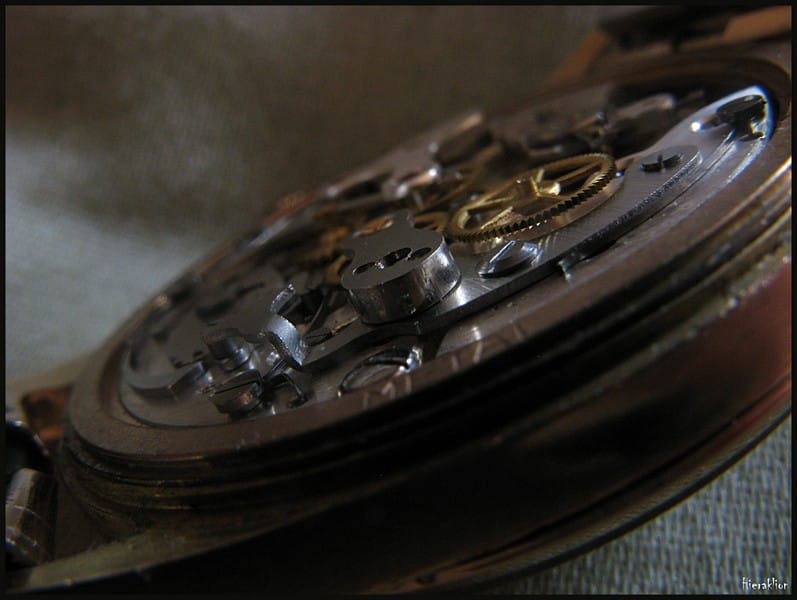

Acknowledgements
Thanks to FreddyLombard, Olivier360 from http://www.horlogerie-suisse.com/forum for identifying the hallmarks and kelorkilé and plume68 from http://forumamontres.forumactif.com for identifying the movement.
Christophe B. for Passion Horlogère
Frequently asked questions
“Chronographe Suisse” is a Swiss watch brand whose pieces, fitted with movements such as the Landeron 48, typically date from the late 1930s to the early 1940s. These are mechanical chronographs generally presented in an 18k gold case with a 37 mm diameter.
Studying the hallmarks (Helvetia woman’s head used from 1933 to 1995, fineness hallmark, serial number, maker’s hallmark) allows you to place a piece in time. The caliber, here the Landeron 48 produced from 1937 to 1970, also gives a dating range.
The movement is a Landeron 48, a cam chronograph produced from 1937 to 1970 in around 3,500,000 units. Characteristics: 13.75 lignes (Dia. 31 mm), height 6.2 mm, 17 jewels, frequency 18,000 vph, power reserve of 42 h, manual winding.
The telemeter scale (red, middle) measures the distance between the observer and a phenomenon that is first visible then audible (lightning, for example). The tachymeter scale (blue, outer) allows the measurement of fast speeds.
At the time, telephone charges were calculated in 3-minute brackets. The minute counter at 3 o’clock therefore has longer divisions for the 3rd, 6th and 9th minutes, in order to time the duration of a telephone conversation.
The Helvetia hallmark is a woman’s head attesting to the Swiss origin and the gold fineness of the piece. It was used from the federal law of 20 June 1933 until 1995, when it was replaced by a Saint Bernard head. The letter under the head indicates the town of the assay office (G for Geneva, C for La Chaux-de-Fonds).
