

Are there still any vintage Rolex watches within reach of collectors on a limited budget? Beyond the unattainable Daytona, the rare GMT-Master, or the highly sought-after Submariner , one model produced from 1953 to 2011 has everything it takes to enrich a collection : the Turn-O-Graph ! Let us explain.
On this page
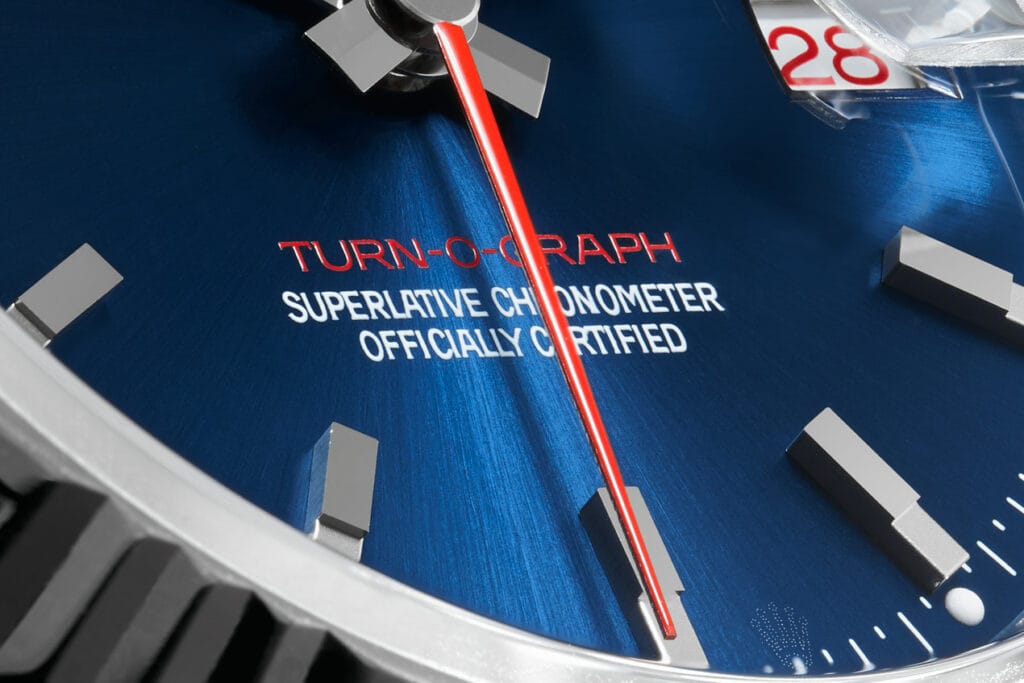
As any good Larousse dictionary points out, a collection is “a set of objects gathered and classified for their documentary or aesthetic value, for their price, their rarity, etc.” Many enthusiasts of fine watchmaking, whether they are compulsive, considered, or occasional buyers, wish to acquire at least one Rolex watch, out of genuine affinity with the brand or to realise an investment. The outrageous prices of certain references nonetheless put more than a few off. One model, however, deserves their attention : the Datejust Turn-O-Graph.

The origins of the Turn-O-Graph
Launched in 1953 by Rolex under the reference 6202, the Turn-O-Graph boasts a character of its own built around a 36mm-diameter Oyster case, a dimension that would remain unchanged until it left the catalogue. With this model, the crowned manufacture set out to offer the “simplest chronograph there is.” The principle is rudimentary and logical. You simply align the first marker of the graduated scale on the rotating bezel with the minute hand to read timed intervals over 60 minutes to the nearest minute. The Turn-O-Graph aimed to embody the ideal tool watch thanks to its versatility.

And the Turn-O-Graph becomes a Datejust
To set it apart from the Submariner unveiled the same year, the rotating bezel is bidirectional and features a differently divided graduation. That of the Turn-O-Graph has more precise markers positioned around its entire circumference. To distinguish the two models definitively, the watch joined the Datejust collection as early as 1954. The following reference, the 6309, was then set apart by its emblematic Cyclops date magnifier. The A260 calibre, used originally, was replaced by the 743. Rolex presented its Turn-O-Graph as a piece to be worn in all circumstances by active men, while the Submariner was now the ally of underwater explorers.
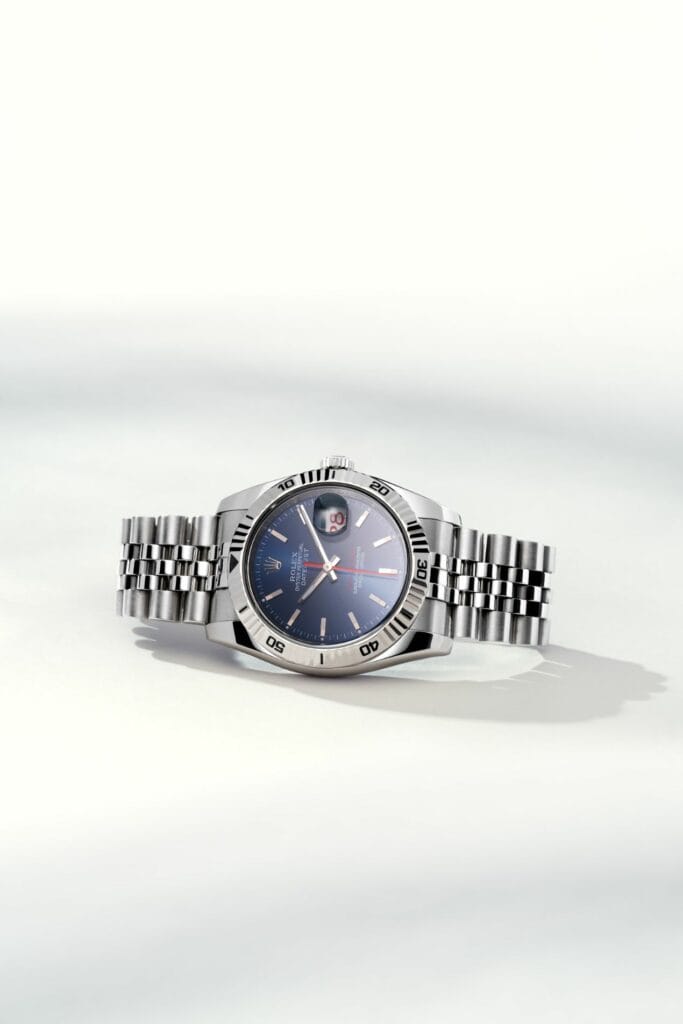
The era of Rolesor and sport-chic
This positioning would henceforth be reinforced with the arrival of Rolesor versions, the famous combination of gold and steel signed Rolex. The Datejust Turn-O-Graph is one of the first watches to enjoy a two-tone aesthetic with a gold bezel and a steel case paired with a bracelet that is likewise of mixed materials, gold in the centre and steel on the outer links. Rolex invented sport-chic well before the 1970s and the current revival trend.
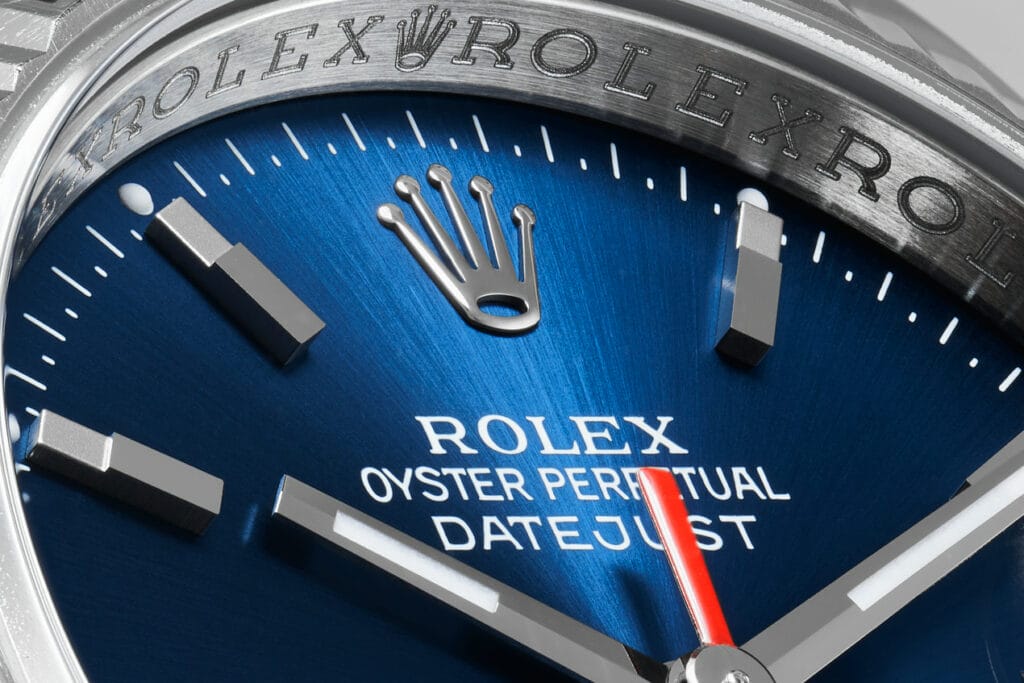
Later, the Datejust Turn-O-Graph was offered in multiple variations, in steel or gold. The dials came in white, black, a silvered or champagne hue. Its bezel kept gaining in precision with a triangle at 12 o’clock, the numerals for the tens, and dashes between each of them.

References and technical developments
The reference 1625 fitted with the calibre 1570 was thus assembled from 1959 to 1977. Its self-winding movement delivers 48 hours of power reserve. The performance is comparable to current standard mechanisms, with one notable difference, however: its chronometry is certified by the Swiss Official Chronometer Testing Institute (COSC) !
In the 1990s, production of the Datejust Turn-O-Graph continued and embraced the aesthetic trends of the time. The ref. 16264 dated 1995 notably combines steel with white gold.
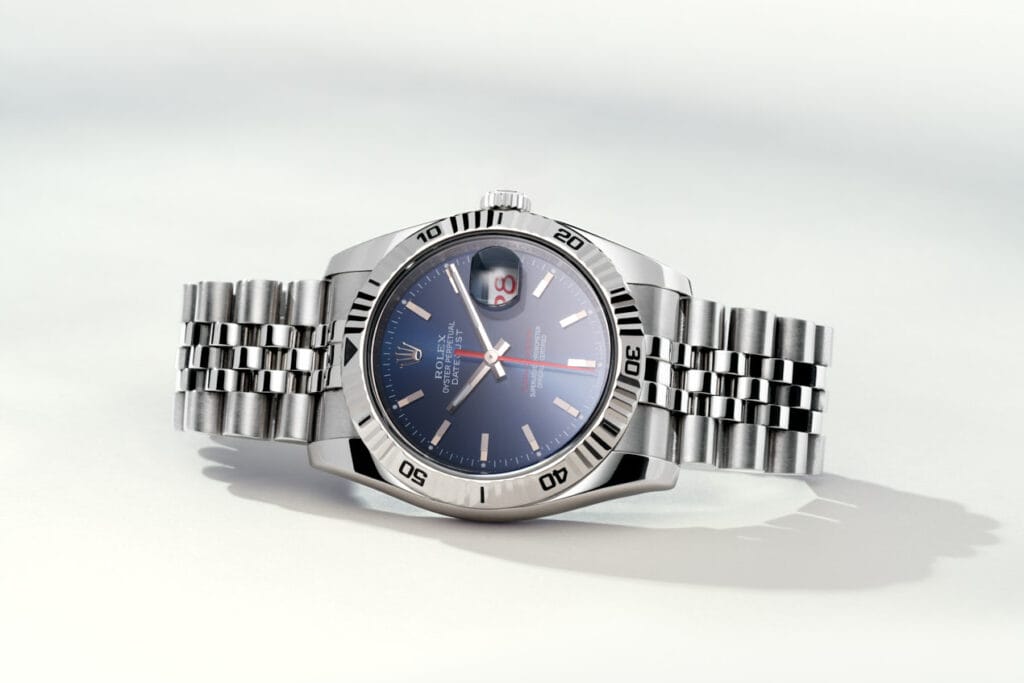
The comeback in the 2000s
The neglected timepiece came back to the fore from 2004 in various versions. One of them, the ref. 116264, features on its sunburst blue dial a date and a red seconds hand. Details also found on other interpretations bearing six-digit references. Many of them likewise carry on the Rolesor principle : the ref. 116263, 904L steel and yellow gold, the ref. 116261, steel and rose gold… Their common features? A redesigned bezel that becomes emblematic. All are driven by the robust and precise calibre 3135, COSC chronometer-certified and equipped with numerous technical improvements including the Parachrom hairspring.
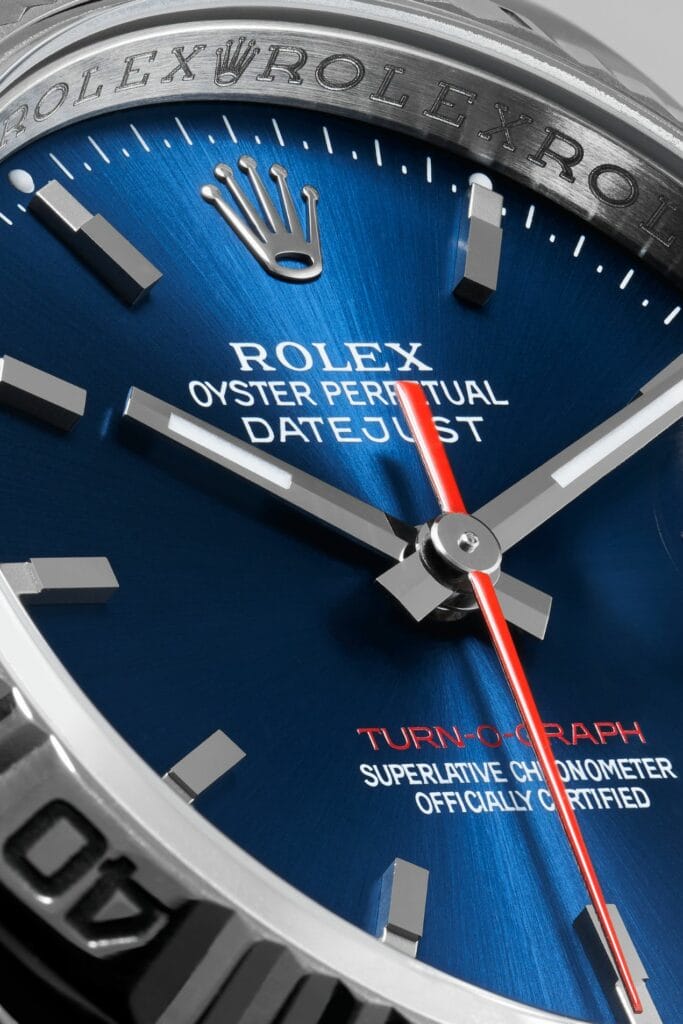
Remarkable historical references
In 2011, the Datejust Turn-O-Graph quietly left the stage, bequeathing its fluted bezel that had become an aesthetic signature of Rolex. Today, the early models are of course sought after, as are rare pieces displaying on their dial the insignia of the Thunderbirds aerobatic squadron and the Thunderbird inscription. In the late 1950s, these United States Air Force pilots adopted the Datejust Turn-O-Graph as their official watch. The many classic or Rolesor references should not be overlooked for all that and can help enrich or begin a collection.
Next year gives Rolex the chance to celebrate the 70th anniversary of the Datejust Turn-O-Graph. An ideal date to bring back a contemporary model, an aesthetic evolution of its fluted bezel, and to highlight the history of this little-known watch, the future star of collectors ?
Frequently asked questions
The Turn-O-Graph was launched in 1953 under the reference 6202, with a 36 mm Oyster case. As early as 1954, it joined the Datejust collection under the reference 6309.
The Turn-O-Graph stands out for its bidirectional rotating bezel graduated around the entire circumference, allowing intervals to be timed over 60 minutes by aligning the marker with the minute hand. The classic Datejust keeps a fixed bezel (smooth or fluted).
Besides the original 6202 and the 6309, the reference 1625 (calibre 1570, 1959-1977) marks the vintage era. In the 1990s-2000s, we find the 16264 and the six-digit references such as the 116264, the 116263 Rolesor yellow gold, or the 116261 rose gold, all driven by the calibre 3135.
In the late 1950s, the pilots of the United States Air Force’s Thunderbirds aerobatic squadron adopted the Datejust Turn-O-Graph as their official watch. A few rare dials bear the Thunderbird insignia and inscription, particularly sought after.
In 2011, the Datejust Turn-O-Graph left the Rolex catalogue after nearly 60 years of continuous production, bequeathing its fluted bezel that had become an aesthetic signature of the brand.
Unlike the Daytona, GMT-Master, or Submariner, whose values have skyrocketed, the Turn-O-Graph remains accessible to collectors on a limited budget. With the Datejust’s 70th anniversary approaching, its historical and technical qualities could make it a future star among collectors.
Text by Dan Diaconu for Passion Horlogère,
Photos by Alexandre Tarall for Passion Horlogère
