

Some watchmaking collaborations look like commercial no-brainers. Others have more of a plot twist about them. The one that now unites Audemars Piguet and Swatch belongs to this second category. Because it took nerve. Nerve to bring together the manufacture from Le Brassus — an independent, family-owned house, almost sacred in the imagination of collectors — and Swatch, a popular, colorful, industrial, irreverent brand whose historic mission has always been to make Swiss watchmaking desirable to the widest possible audience.
On this page
- A shift rather than a copy
- The Royal Oak as a cultural language
- Eight watches, two ways of reading time
- A playful object, but a genuine industrial challenge
- The Sistem51 goes hand-wound
- Pop Art, Royal Oak and popular culture
- A one-off collaboration, not an endless collection
- An operation with no profit for Audemars Piguet
- A useful provocation
- The watch everyone will talk about
- Frequently asked questions
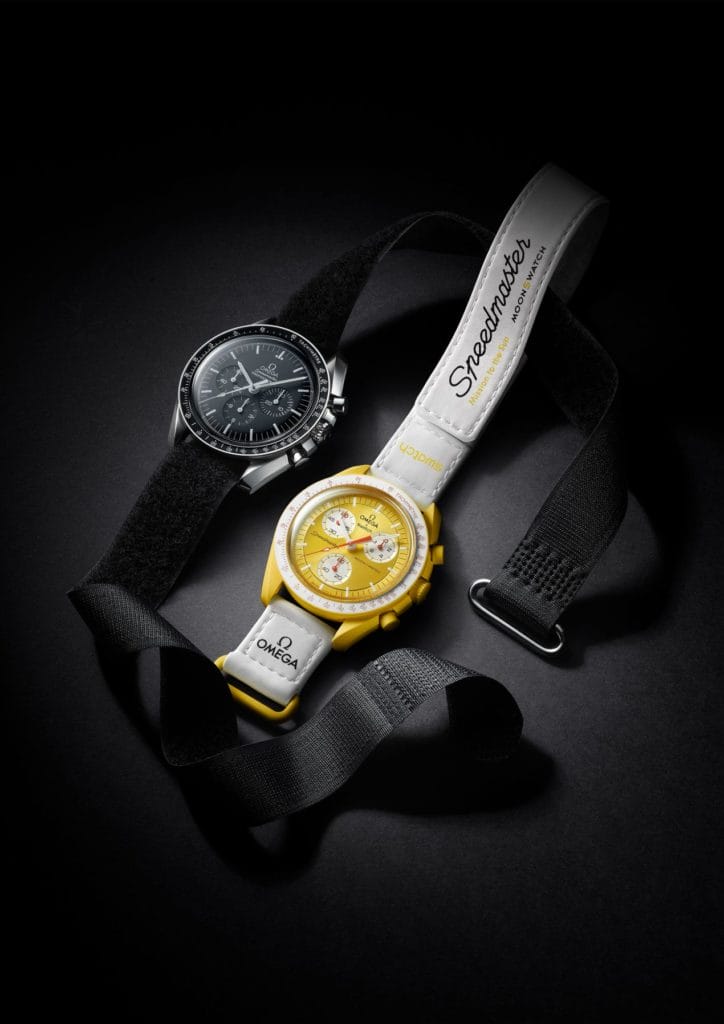
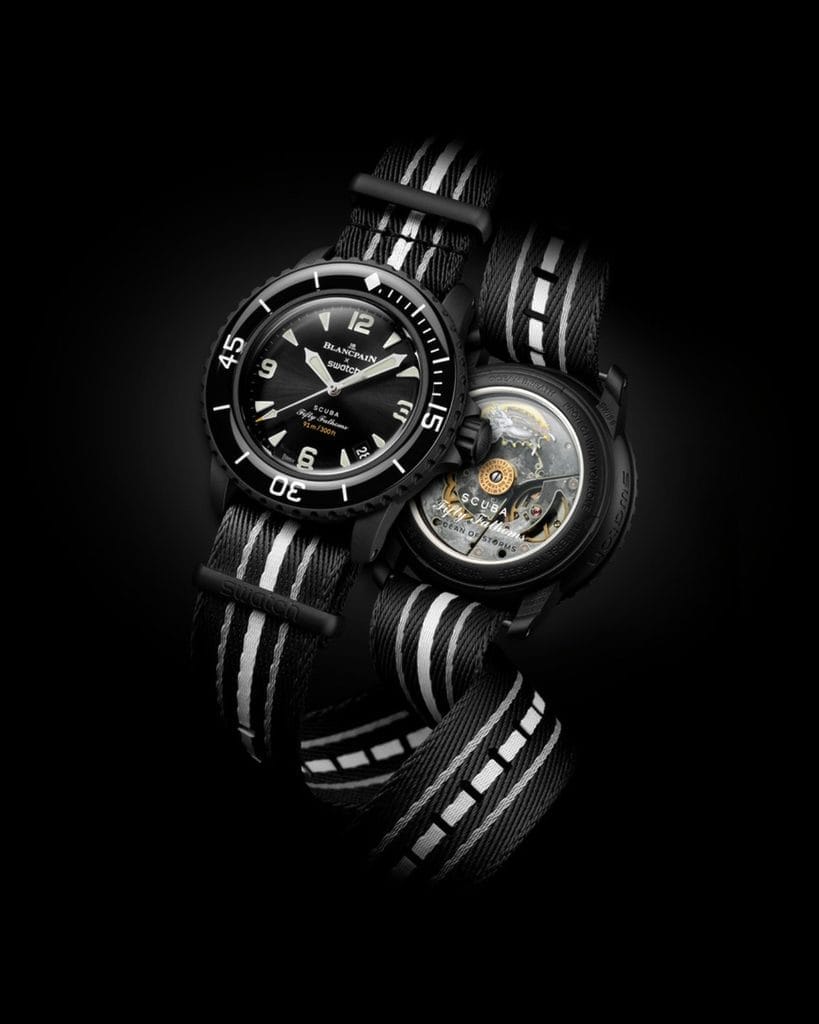
After the MoonSwatch with Omega, then the Scuba Fifty Fathoms with Blancpain, Swatch is therefore taking a further step. This time, the operation no longer takes place solely within the Swatch Group. It touches one of the absolute icons of contemporary watchmaking: the Audemars Piguet Royal Oak. Enough to set a few teeth on edge, make many enthusiasts smile, and spark that kind of worldwide commotion of which Swatch still holds the secret.
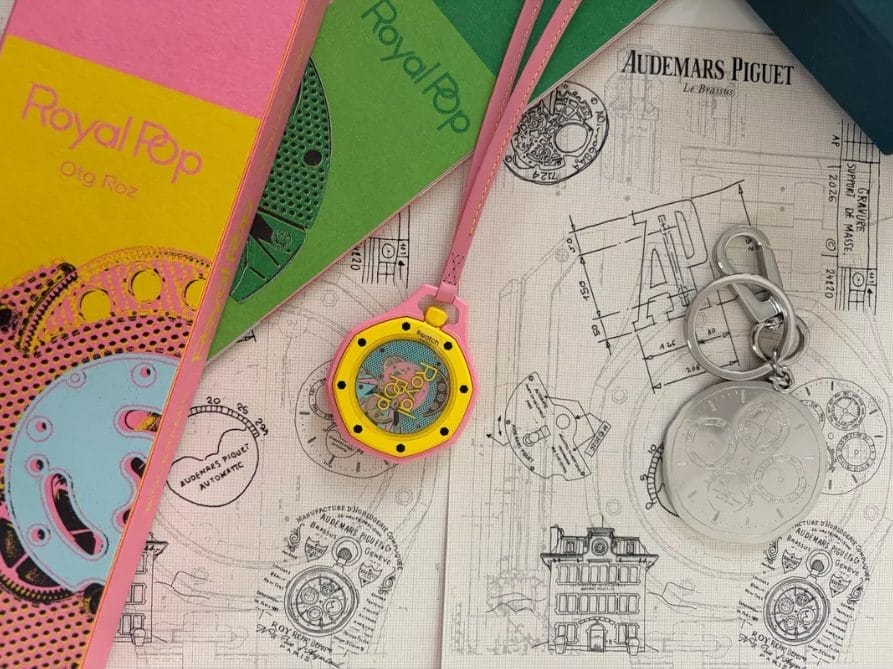
But the most interesting part is not only in the pairing of the two names. It lies in the choice of the object. Contrary to what many imagined, the Royal Pop is not a bioceramic Royal Oak for the wrist. It is not an “accessible” Royal Oak, nor a simplified take on the 1972 icon. It is something else: a contemporary, colorful, mechanical, convertible pocket watch, designed to be worn somewhere other than on the wrist.
A shift rather than a copy
This is probably where the intelligence of the project lies. Audemars Piguet and Swatch could have taken the most obvious route: borrow the Royal Oak’s silhouette, dress it in bioceramic, give it an integrated bracelet and instantly trigger endless queues. Success would have been guaranteed. So would the debate.
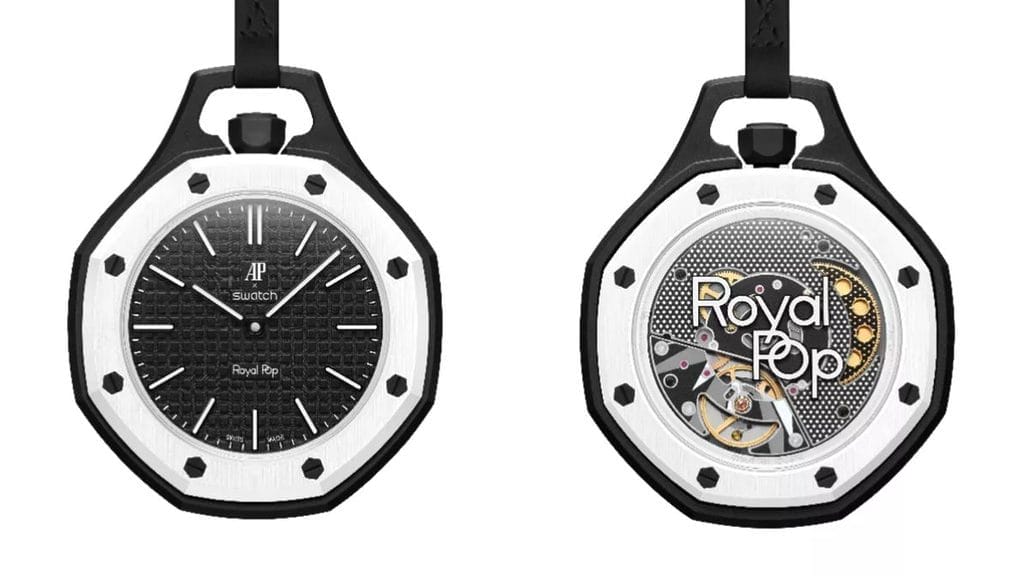
Instead, the two houses chose displacement. The Royal Pop takes up the Royal Oak’s strong signifiers: octagonal bezel, exposed screws, dial inspired by the Petite Tapisserie, an immediately recognizable silhouette. But it transposes them into an object that escapes the usual register of the wristwatch.
Grégory Kissling, head of special projects at the Swatch Group, sums up the essential with a simple formula: “This is not a wristwatch.” That sentence is enough to grasp the nature of the exercise. The point is not to offer the general public a fake Royal Oak, but to create a parallel watchmaking object, inspired by the history of the Le Brassus house and by the free spirit of Swatch.
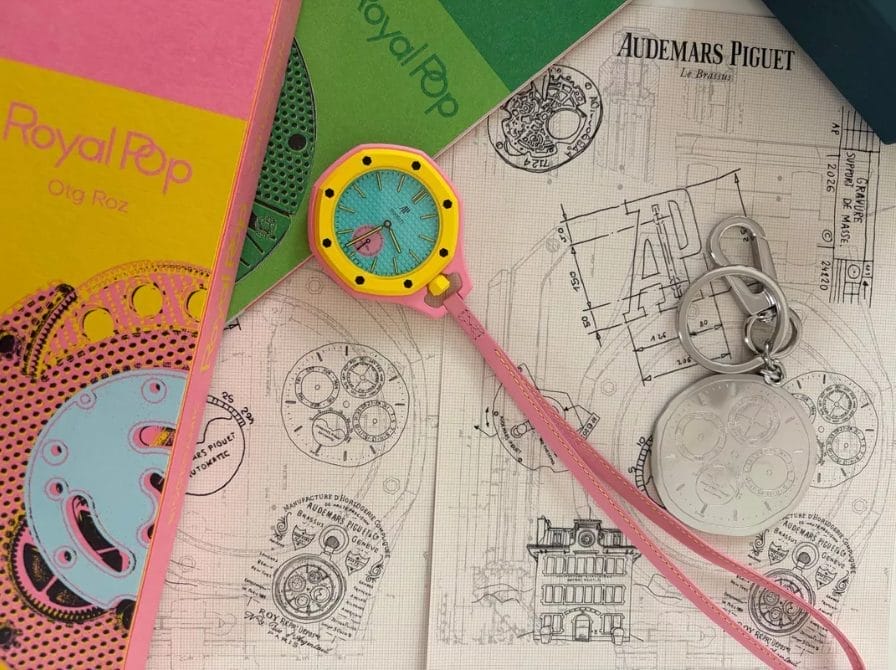
The Royal Pop is worn around the neck, in a pocket, clipped to a bag, or even set on a table thanks to a removable stand. It thus recovers a freedom of wear that contemporary watchmaking had largely forgotten. Before being confined to the wrist, the watch lived in pockets, hung from chains, sat on desks, slipped into the gestures of everyday life. The Royal Pop reactivates that memory, but with the colors and the boldness of a pop object.
The Royal Oak as a cultural language
Since 1972, the Royal Oak has no longer been merely a watch. It has become a language. Its octagonal bezel, its eight screws, its tapisserie dial and its integrated bracelet have shaped a new definition of the chic sports watch. In its day, it had already caused a shock. A steel watch offered at the price of a gold watch, designed by Gérald Genta, made with an unprecedented degree of exactingness, could not leave anyone indifferent.
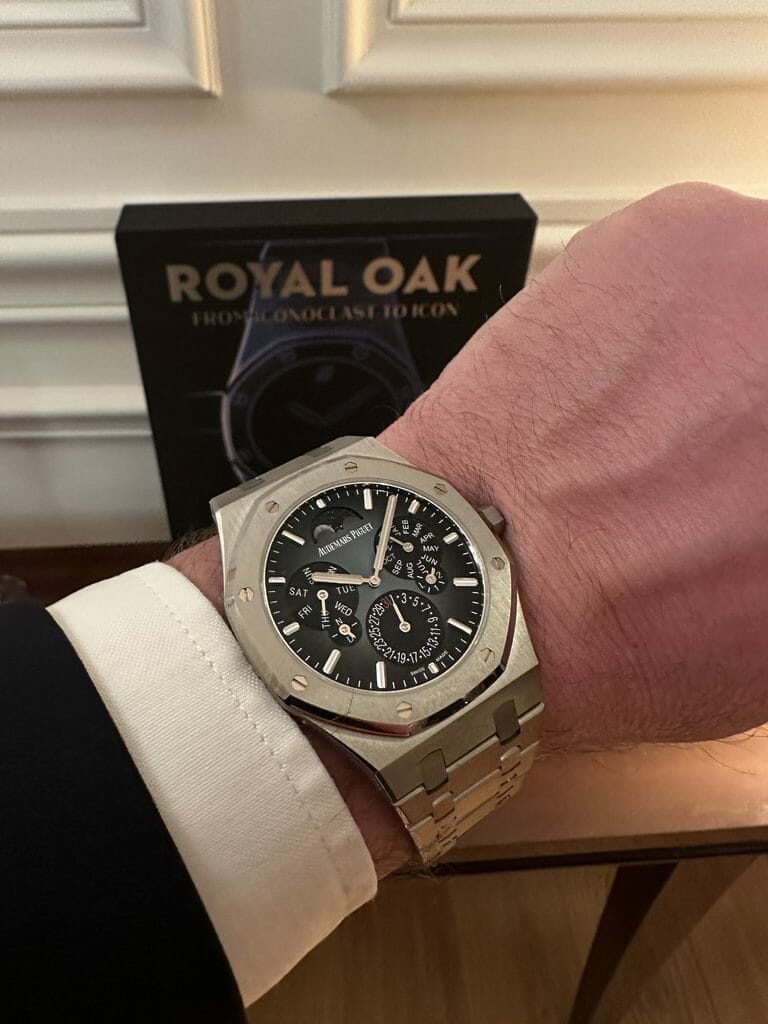
More than half a century later, the icon has become an object of desire, of speculation, sometimes of frustration. Its rarity, its prices, its social status and its aura have helped turn it into the absolute symbol of watchmaking success. It is precisely this status that the Royal Pop comes to shake up — not by destroying it, but by shifting it.
The approach can be read in two ways. Purists will see in it a provocation, perhaps a trivialization of Audemars Piguet’s codes. Others will read it as an attempt to open up the Royal Oak’s narrative to a new audience. Ilaria Resta, president of Audemars Piguet, embraces this logic of openness. In remarks gathered by Judikael Hirel, she speaks of the need to address younger generations and to bring a new audience into the world of mechanical watchmaking.
The most important word is perhaps “megaphone,” used to describe Swatch’s power. Audemars Piguet knows perfectly well that Swatch speaks to audiences that haute horlogerie does not always reach. Teenagers, young adults, design lovers, the curious, occasional collectors, buyers who would never spontaneously step through the door of an AP House. In that sense, the Royal Pop is not only a watch. It is a conversation tool.
Eight watches, two ways of reading time
The collection is made up of eight models. The number is obviously no coincidence. Eight like the sides of the octagonal bezel. Eight like the screws that structure the face of the Royal Oak. Eight like an immediately recognizable signature, transformed here into a principle of the collection.
These Royal Pop watches measure 40 mm in diameter and 8.4 mm in thickness. They are made of bioceramic, the emblematic material of Swatch’s recent collaborations, composed of ceramic powder and a bio-sourced material derived from castor oil. The watch is light, colorful, accessible, but the care given to certain details shows that the exercise is not limited to a mere marketing product.
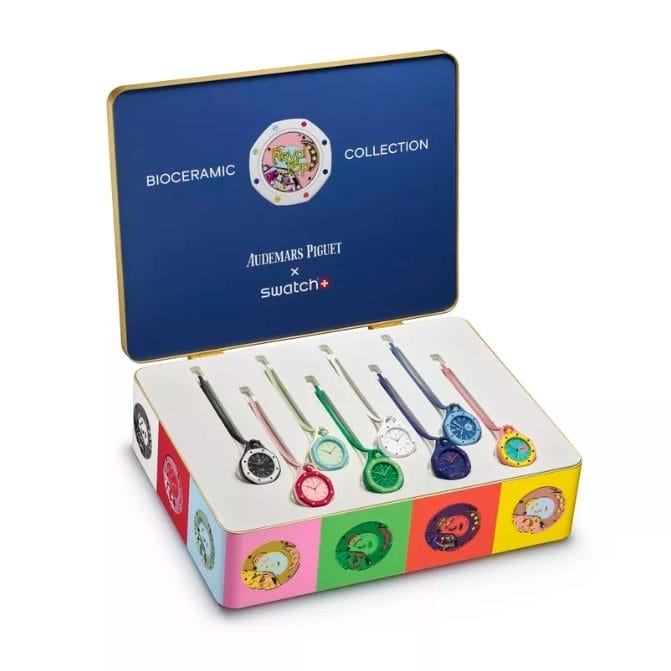
Two types of display are offered. Six models adopt a pocket-watch-type architecture with the crown at 12 o’clock and two hands. Two other models add a small seconds at 6 o’clock, with a crown positioned at 3 o’clock and a slightly offset reading of the time. The former are announced at 385 euros, the latter at 400 euros.
Distribution will follow the logic now familiar from Swatch’s major collaborations: in-store sales only, a limit of one watch per person, per day and per store, and a launch planned for 16 May. The queues should therefore be an integral part of the show. Nick Hayek makes no secret of it: this phenomenon now belongs to the mechanics of worldwide desire that Swatch knows how to provoke.
A playful object, but a genuine industrial challenge
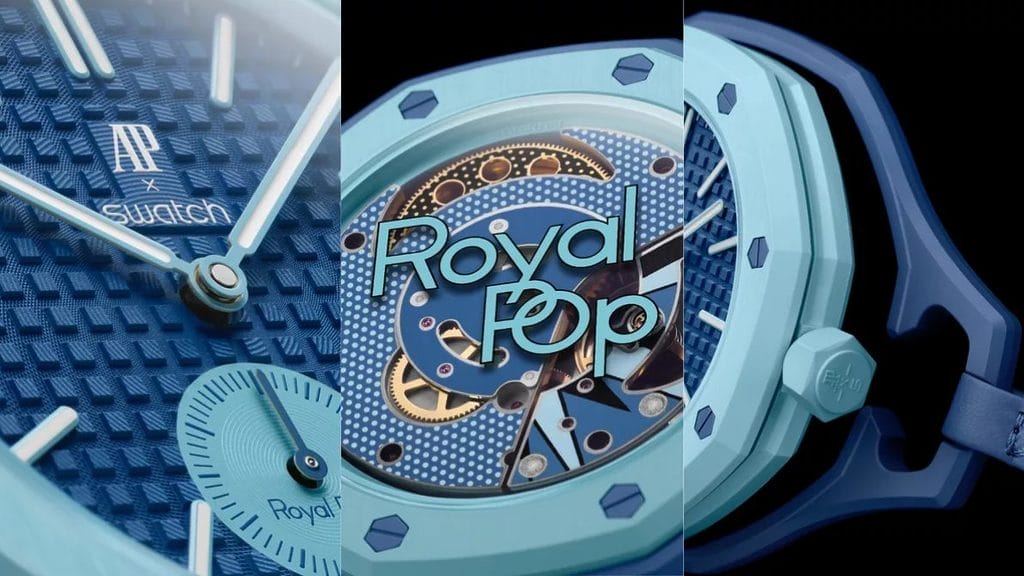
The Royal Pop would be less interesting if it relied only on a colorful exterior. Yet the project reveals an industrial effort more ambitious than it appears. The dial takes up the Petite Tapisserie motif, but it had to be translated into a Swatch language. Grégory Kissling explains that the dial of a Royal Oak was scanned in order to develop a mold capable of reproducing this motif in relief. Color, varnishing, surface rendering: everything required specific development.
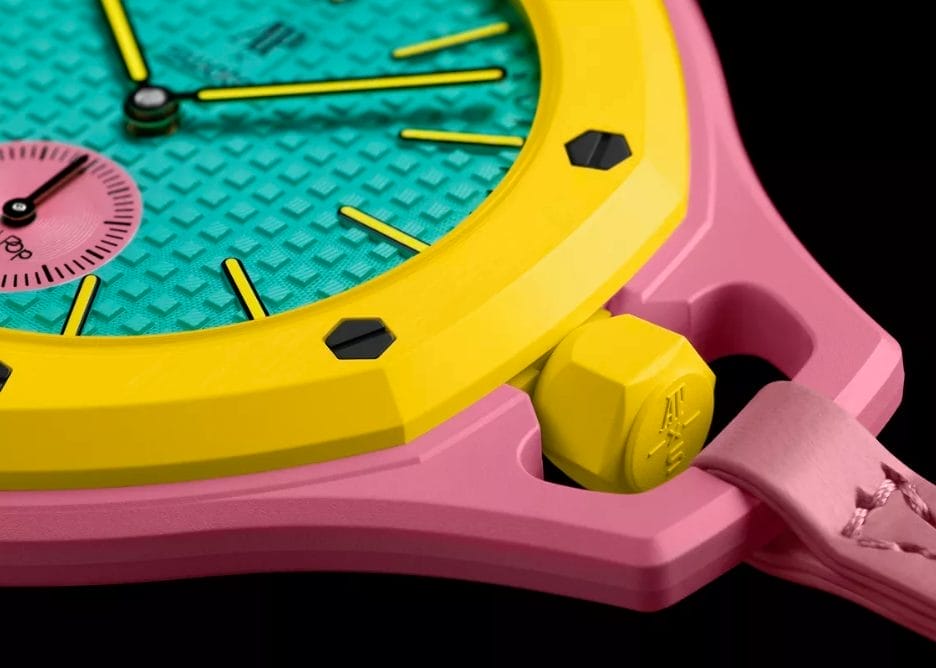
The bezel and the case back receive a vertical satin finish. This detail is essential. On a Royal Oak, the interplay of brushed, polished, taut and angular surfaces is part of the watch’s visual identity. Transposing it onto bioceramic was anything but obvious. This termination had to be integrated into the molds and a way had to be developed to bring life to a material that, by nature, does not obey the same constraints as steel.
Nick Hayek speaks of an object that sits in the hand like a “precious candy.” The phrase is well chosen, because it says everything about this Royal Pop: a deliberately indulgent object, almost childlike in its colors, but treated with a kind of industrial seriousness. Two sapphire crystals, front and back, reinforce this impression of unexpected quality in the Swatch universe.
The Sistem51 goes hand-wound
The movement is the other surprise. The Royal Pop is powered by the Sistem51, but in a hand-wound version. This choice is consistent. A pocket watch, worn intermittently, does not necessarily call for the same type of automatic mechanism as a wristwatch. Hand winding puts a simple watchmaking gesture back at the center of the experience.
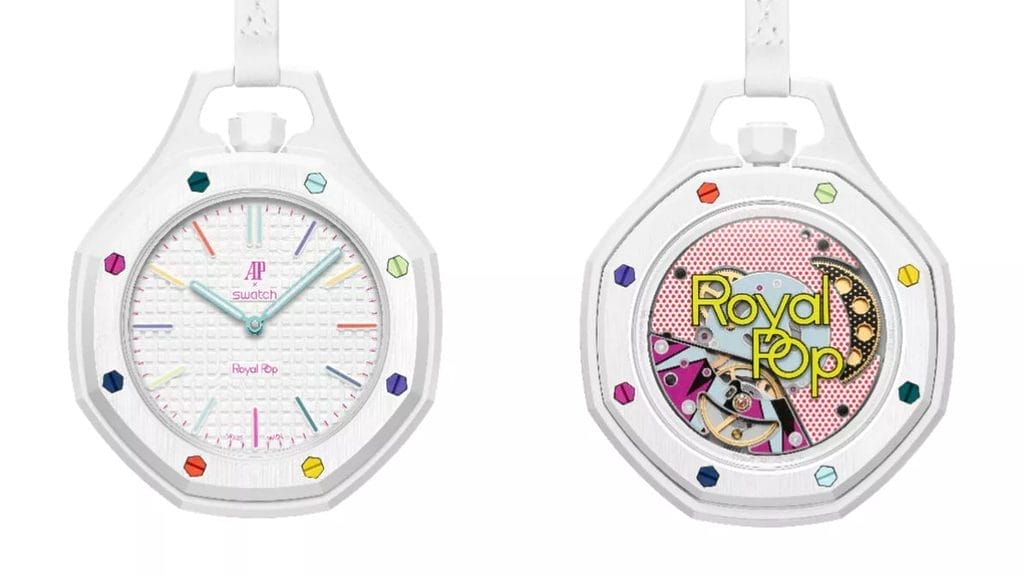
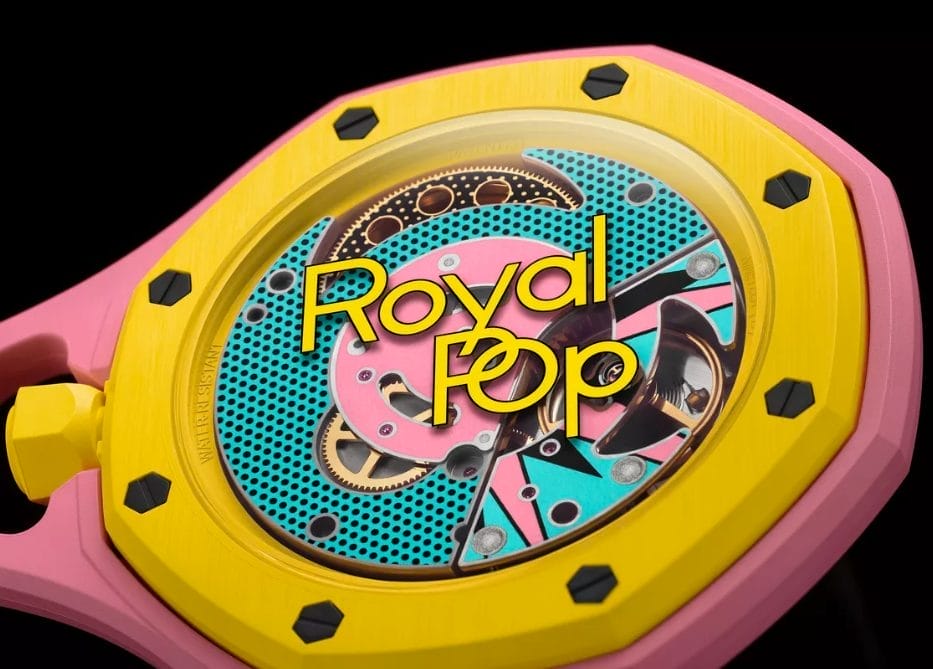
This Swiss Made mechanical movement, assembled in a fully automated way, remains one of Swatch’s great industrial achievements. In this version, it claims a 90-hour power reserve, a non-magnetic Nivachron hairspring, precision regulation carried out by laser at the factory, and 15 active patents. The transparent case back lets you observe some of its components, but also appreciate a decoration unique to each model, in a spirit inspired by Pop Art.
The barrel drum also plays a functional role. It indicates the watch’s state of wind through a play of colors: when certain areas appear gray, the spring needs to be wound; when the whole turns golden, the spring is fully armed. It is simple, visual, legible, and perfectly in tune with the Swatch spirit.
Pop Art, Royal Oak and popular culture
Nick Hayek himself draws a link between the Royal Oak, Pop Art and the idea that a simple object can become a cultural work. This reference is not gratuitous. Swatch has always been more than a watch brand. Since the 1980s, it has been able to turn the watch into a graphic medium, a fashion accessory, a sign of the times, sometimes even a field of artistic expression.
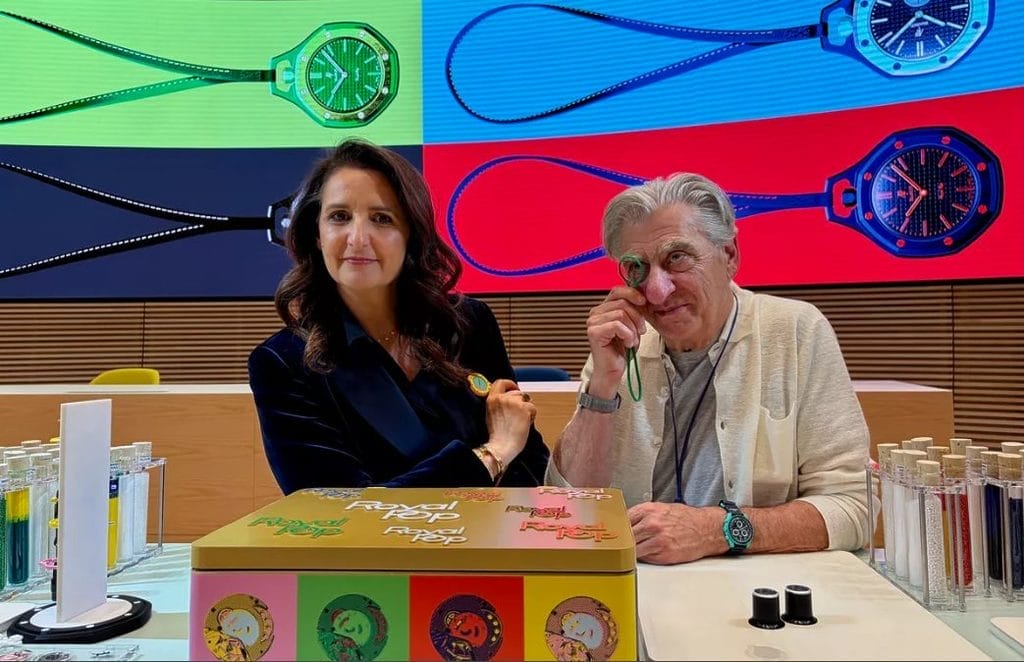
Audemars Piguet, for its part, left the strict territory of classic haute horlogerie long ago. The manufacture has collaborated with the Marvel universe, with Travis Scott, with artists, athletes and designers. The Royal Pop fits into this continuity: that of a brand that does not wish to remain locked in the silent reverence of its icons.
This collaboration should therefore not be read as an absolute contradiction. Swatch brings the color, the access, the popular energy. Audemars Piguet brings the legitimacy, the design, the historical depth, the symbolic weight. The result is deliberately hybrid. And that is no doubt what makes it interesting.
A one-off collaboration, not an endless collection
Unlike the MoonSwatch, the Royal Pop is presented as a one-off collaboration around eight watches. Nick Hayek hints that production will be limited in time, with no definitive schedule or announced quantities. This blur between availability, rarity and desirability is part of the equation.
With production having started later in order to preserve secrecy, the first weeks risk fueling the same phenomena as previous Swatch launches: queues, frustration, speculation, immediate resale, online debates and media frenzy. Some will denounce a strategy of organized scarcity. Others will simply see it as the consequence of a globally desirable object.
What is certain is that the Royal Pop will be commented on by people who will never buy it, criticized by enthusiasts who will queue all the same, and watched very closely by the entire watchmaking industry.
An operation with no profit for Audemars Piguet
One point deserves to be highlighted. Audemars Piguet will draw no direct financial profit from this collaboration. The funds received by the manufacture are to be devoted to an initiative dedicated to preserving and passing on watchmaking know-how, in particular the rare crafts and the training of new generations.

This element gives the project another dimension. The Royal Pop is not content to ride on the aura of the Royal Oak. It also becomes a lever for education and transmission. Ilaria Resta sees in this collaboration a “wonderful gift” for the watchmaking ecosystem. The phrase may sound ambitious, but it says something true: watchmaking needs to spark vocations, to create desire, to make people dream beyond the narrow circle of already-convinced collectors.
Engravers, setters, craftspeople, watchmakers, technicians, engineers: a whole chain of crafts must be preserved. To do that, you need to attract attention. And few brands know how to attract attention like Swatch.
A useful provocation
The Royal Pop will not please everyone. It was probably not designed for that anyway. Some will find it too playful, too colorful, too far removed from the supposed nobility of the Royal Oak. Others will see in it a welcome breath of fresh air in an industry that is sometimes too serious, too expensive, too closed off in its own codes.
What is certain is that the object makes sense. By refusing the wristwatch, Audemars Piguet avoids a head-on comparison with the Royal Oak. By choosing the pocket watch, the manufacture recalls an older part of its history. By teaming up with Swatch, it accepts to speak to a generation that does not yet hold its codes, but that could tomorrow take an interest in mechanical watchmaking.
The Royal Pop is therefore less a democratization of the Royal Oak than an invitation to enter its imaginary world. It does not grant access to haute horlogerie. It grants access to a conversation about haute horlogerie. And that is already a great deal.
The watch everyone will talk about
From 16 May, Swatch boutiques should once again see queues forming. Some will come out of passion. Others out of curiosity. Others still out of opportunism. The phenomenon is predictable, almost scripted. But beyond the noise, what will remain is a singular object: a mechanical, colorful, industrial pocket watch, inspired by one of the greatest icons of luxury watchmaking.
The Royal Pop is smiling, provocative, imperfect perhaps, but profoundly contemporary. It brings together two visions that everything seemed to set in opposition: the heritage exactingness of Audemars Piguet and the popular energy of Swatch. It reminds us that watchmaking is never more alive than when it agrees to step outside its frame.
With this Royal Pop, the Royal Oak leaves the wrist. But it may gain a new territory: that of popular culture.
Frequently asked questions
It is a collaboration between Audemars Piguet and Swatch comprising eight bioceramic pocket watches, inspired by the visual codes of the Royal Oak (octagonal bezel, exposed screws, Petite Tapisserie dial). It is not a wristwatch: the Royal Pop is worn around the neck, in a pocket or clipped to a bag.
The six two-hand models are announced at 385 euros. The two models with a small seconds at 6 o’clock are offered at 400 euros.
The launch is planned for 16 May. Distribution is exclusively in Swatch boutiques, with a limit of one watch per person, per day and per store.
The Audemars Piguet Royal Oak is a haute horlogerie wristwatch in steel or noble materials, launched in 1972. The Royal Pop takes up its visual codes but transposes them into a bioceramic pocket watch powered by a hand-wound Sistem51. It is neither a variant nor an accessible version of the Royal Oak.
The Royal Pop is powered by a Sistem51 in a hand-wound version, featuring a 90-hour power reserve, a non-magnetic Nivachron hairspring and 15 active patents. The visible barrel drum signals the state of wind through a play of colors.
The stated objective is to speak to an audience that haute horlogerie does not usually reach — younger generations, design lovers, the curious — by drawing on Swatch’s media power. Audemars Piguet receives no direct profit: the funds received are devoted to preserving and passing on watchmaking know-how.
Yes. The collaboration has been officially presented by both houses. Ilaria Resta, president of Audemars Piguet, and Nick Hayek, head of Swatch, have both confirmed the project and its launch on 16 May.
