

Automatic (self-winding) mechanical watches continue to be regarded as true icons, even as smartwatches occupy the spotlight. They are worn as technical objects, but also as symbols of watchmaking culture, heritage, and style.
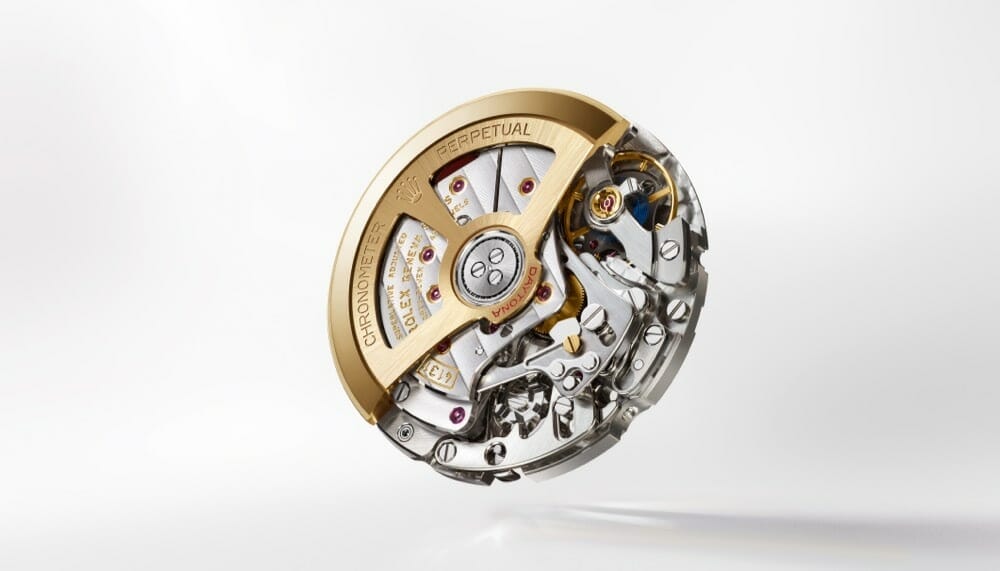
This article draws on the work of Eden Chastres, a student at ISG Luxury Management Paris, who dedicated a presentation and an educational video to automatic mechanical watches. The content here has been enriched with reference horological sources to offer Passion Horlogère readers a complete, instructive synthesis focused on the pleasure of wearing a beautiful watch… especially with the holidays approaching.
On this page
From Shaking Watches to the “Perpetual” Rotor: A History of Ingenuity
Before the invention of automatic winding, every mechanical watch had to be wound by hand each day using a key. That changed in 1847, when Antoine LeCoultre invented the lever-operated winding and setting mechanism, the first simple and reliable system for winding and setting the time by lever, without a key. In other words, the very first lever-winding system that did away with the need for a key.
But a decisive step had already been taken in the 18th century: in 1777, Swiss watchmaker Abraham-Louis Perrelet developed a so-called “shaking” watch, whose mainspring was wound by the movements of the body.

The following year, a very similar system was presented by Hubert Sarton to the Royal Academy of Sciences in Paris, sparking a long-running historical debate over who truly invented the first self-winding watch. Perrelet is generally considered the originator, while Sarton is thought to have refined the solution, as noted in Eden Chastres’s text.
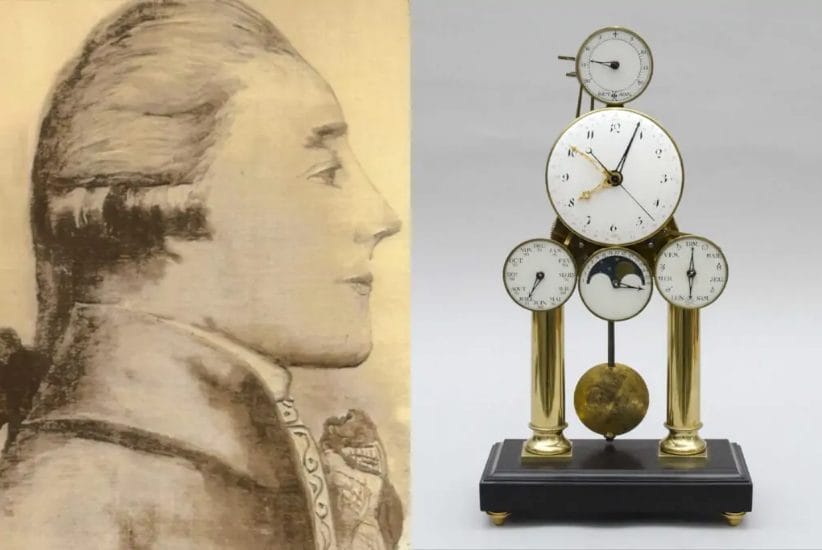
In the 19th century, masters such as Breguet and Leroy further refined these systems, but they remained mostly confined to pocket watches, with mechanisms that were complex and fragile.
The real revolution came in the 20th century. In 1931, Rolex filed a series of patents for a free rotor known as “Perpetual”, capable of spinning a full 360° and winding the mainspring in both directions. Fitted inside a water-resistant Oyster Perpetual, this system laid the groundwork for nearly all modern automatic watches, greatly reducing crown manipulation and, with it, watch wear.
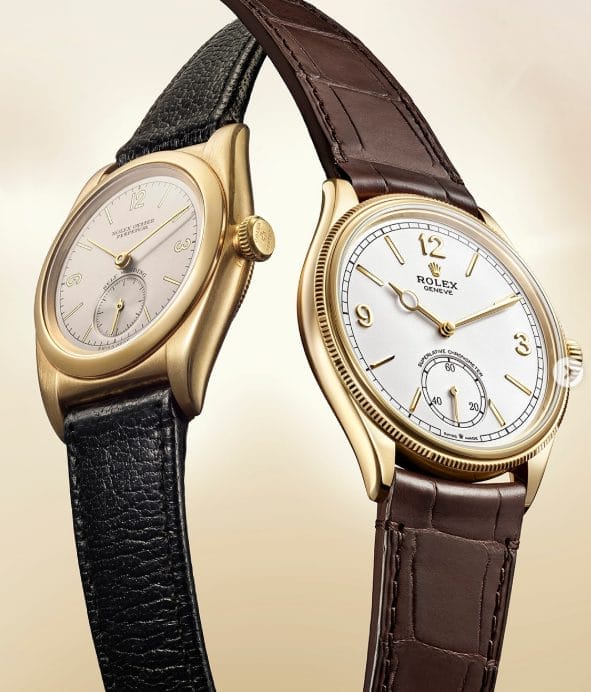
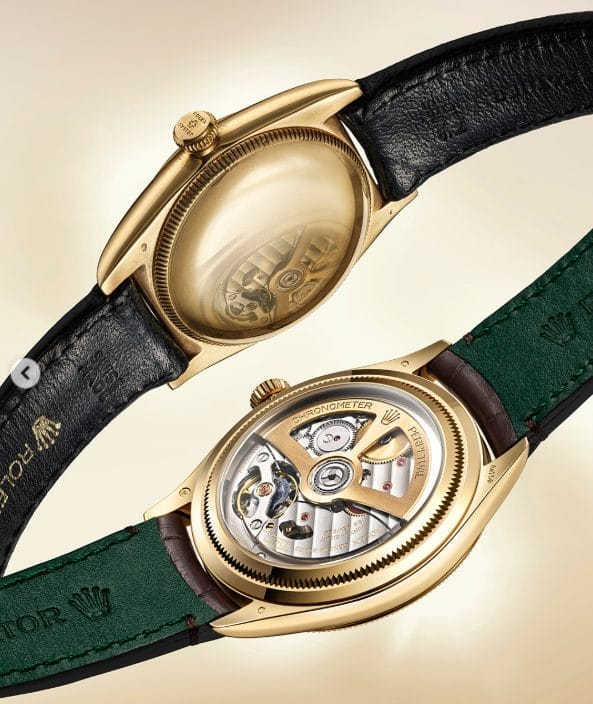
After World War II, the miniaturization of components, the wrist becoming the standard way to wear a watch, and advances in the Swiss industry allowed these automatic movements to spread widely. Automatic winding then became the most practical solution for an everyday mechanical watch, until the arrival of quartz in 1969 and its mass adoption throughout the 1970s and 1980s.

Inside the Movement: How Does an Automatic Watch Work?
An automatic mechanical watch remains, first and foremost, a mechanical watch. Its energy comes from a mainspring housed in a barrel, wound by a winding system and then released gradually to drive the hands.
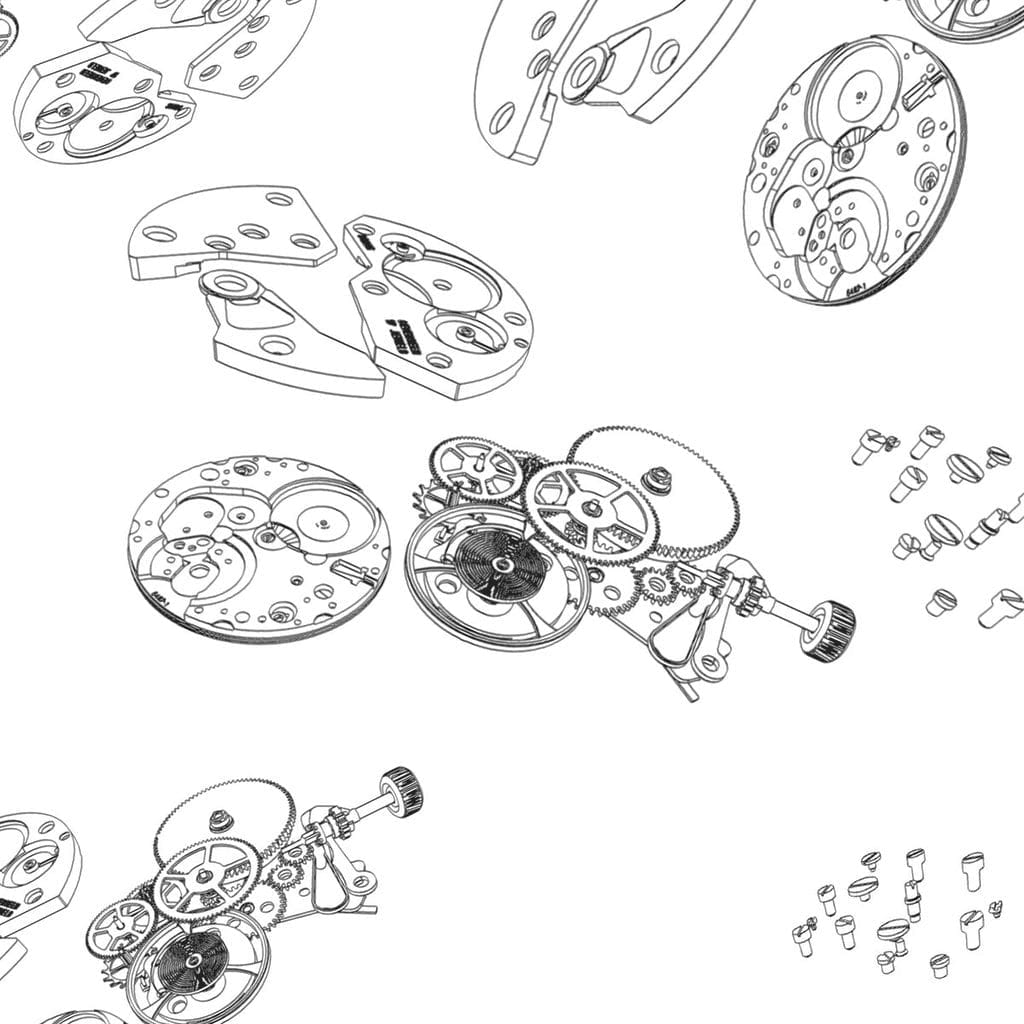
The main components can be presented as follows, as explained in Eden Chastres’s video: rotor, mainspring, gear train, escapement (anchor) and balance wheel.
• The mainspring
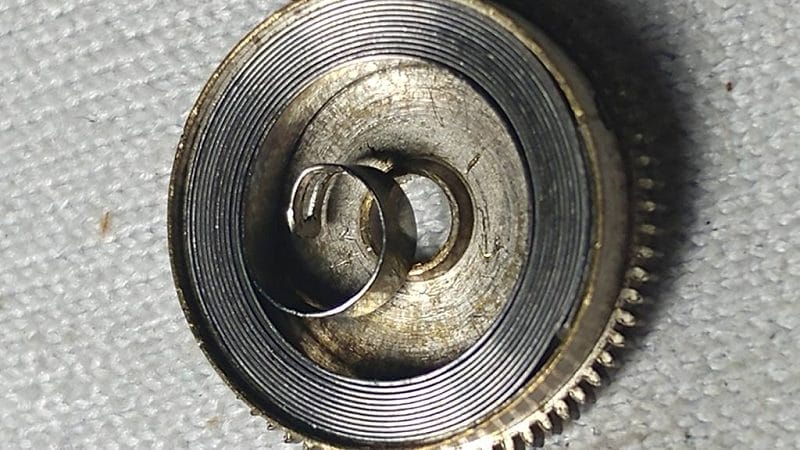
Mechanical energy is stored in a spring made of steel or a special alloy (Nivaflex, for example) coiled inside a barrel. The more tightly wound it is, the more “power reserve” the watch has, that is, the number of hours it will run before stopping. A contemporary automatic watch typically offers between 38 and 72 hours of power reserve, with some going well beyond that.
• The gear train
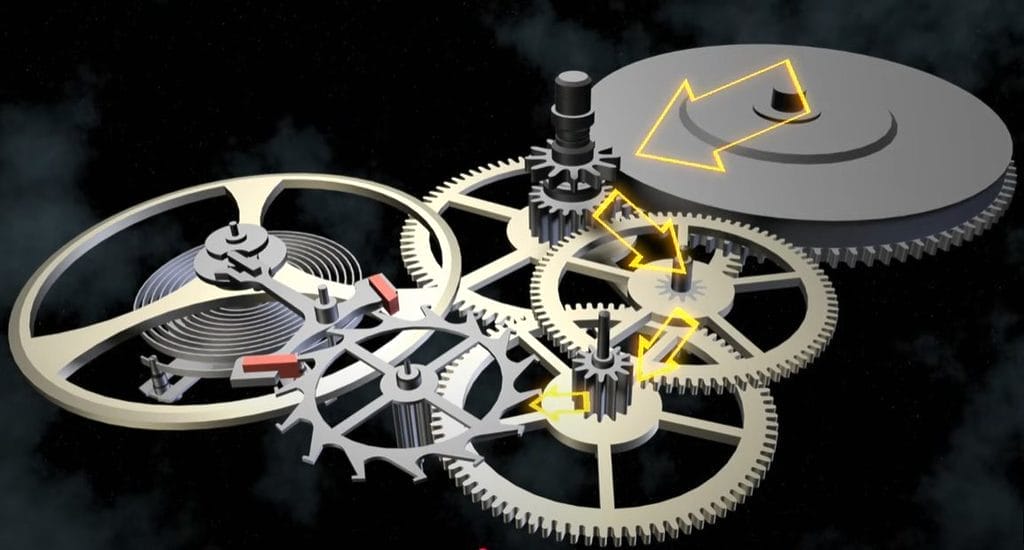
A series of toothed wheels then transmits this energy from the barrel to the hands. This gear train converts the mainspring’s fast rotation into the much slower rotation of the hour, minute, and second hands.
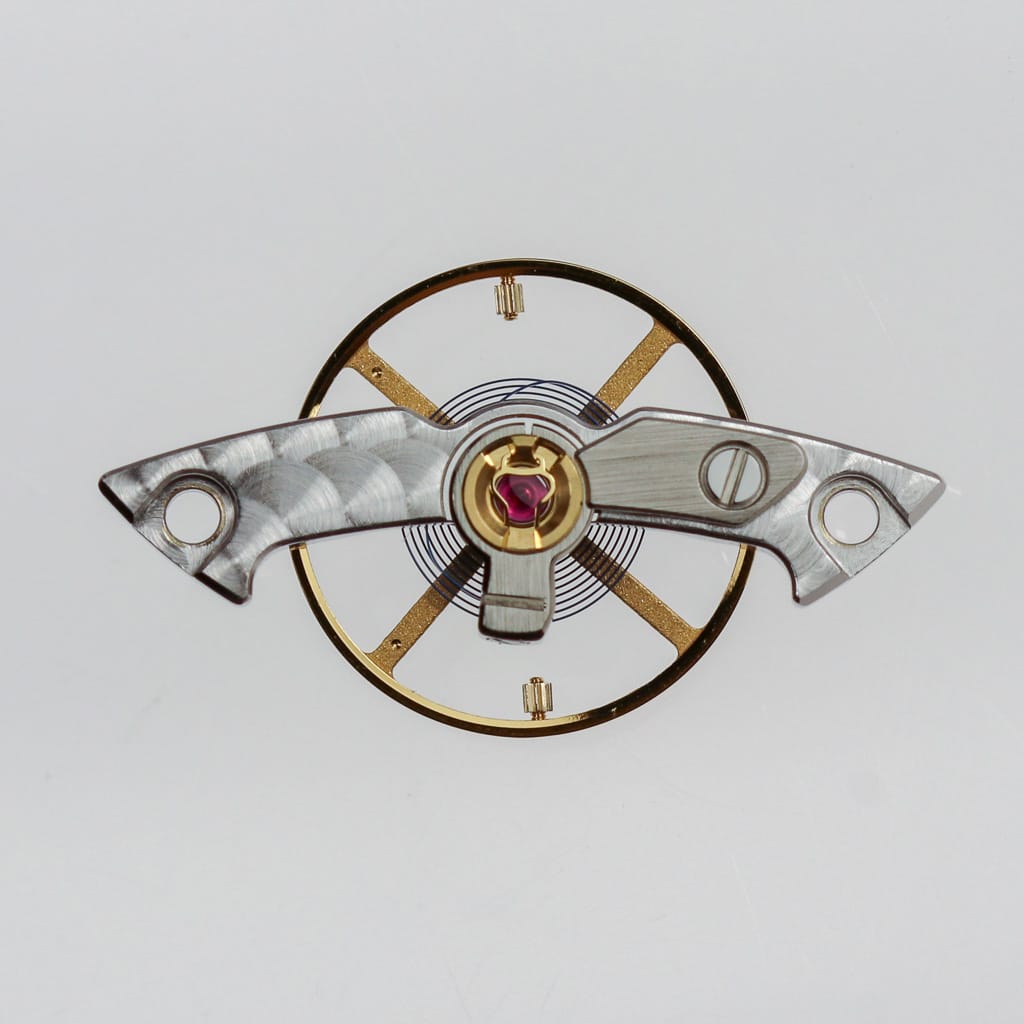
• The escapement and the balance wheel
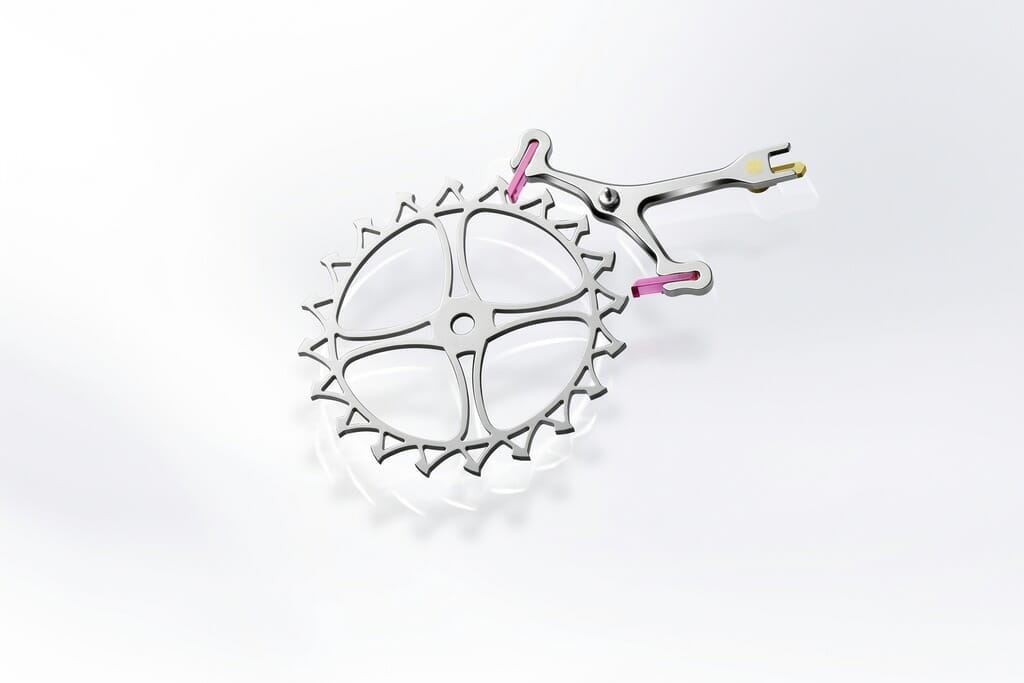
The escapement (often a Swiss lever escapement) delivers energy at regular intervals to the balance spring, which oscillates at a given frequency, 3 Hz (21,600 vibrations per hour) or 4 Hz (28,800 vibrations per hour) in most modern watches. This “beating heart” dictates the watch’s accuracy.
• The rotor and the automatic winding system
What sets the automatic watch apart is the presence of a rotor, a half-moon-shaped oscillating weight that spins freely on its axis as the wrist moves.
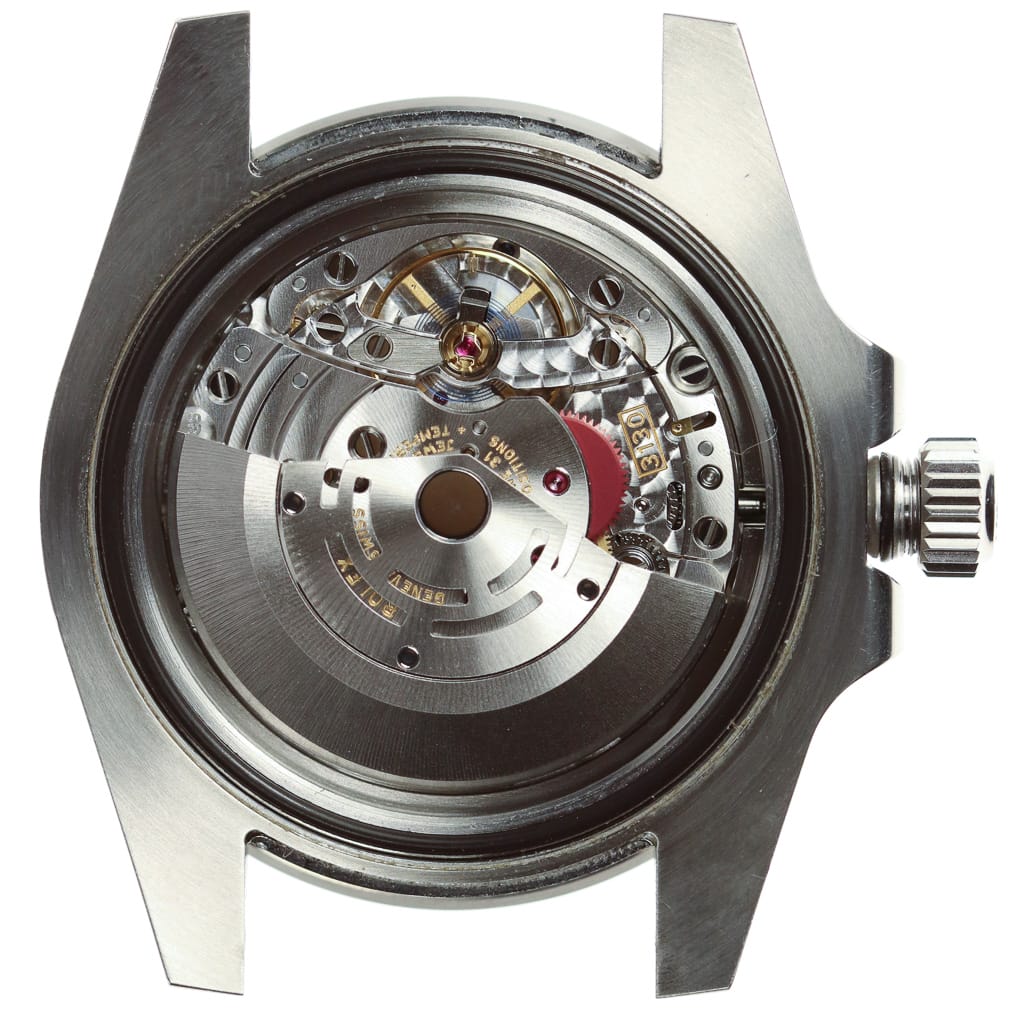
With every movement, this rotor drives a system of reduction wheels and pawls that wind the mainspring. Winding can be unidirectional or bidirectional depending on the caliber. Once the spring is fully wound, a slipping clutch mechanism prevents over-tensioning; Nomos Glashütte notes on its website that the rotor stops turning to protect the movement once the barrel is fully wound.
In most current movements, supplementary manual winding via the crown remains possible. It is even recommended when the watch has stopped and needs to be started again. Explanations from Initium and Aélys highlight that this dual capability is a valuable safeguard when the watch has been left unworn for several days.
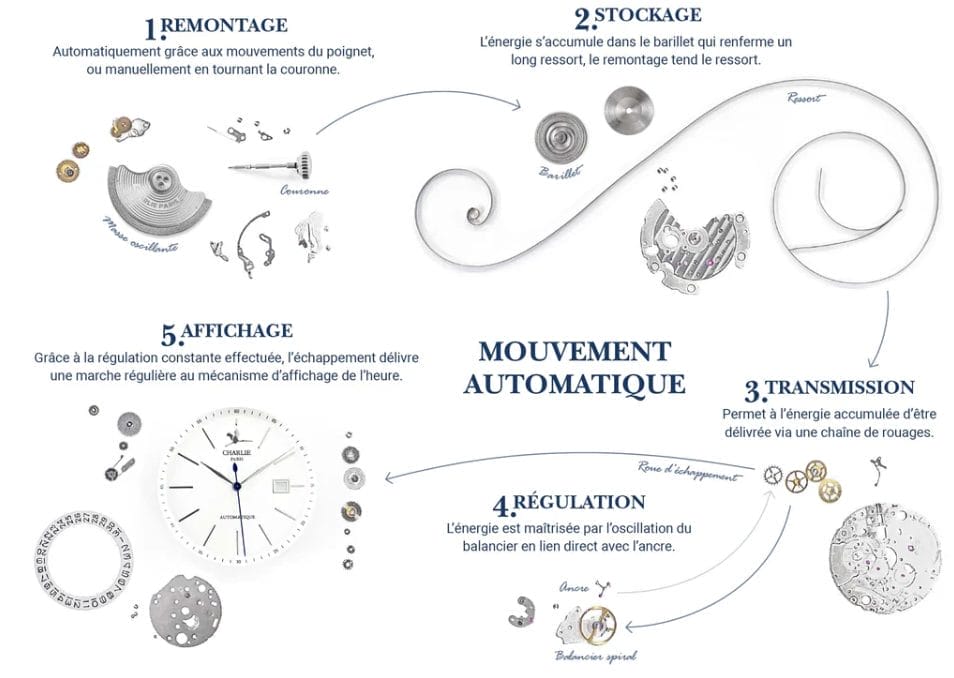
In summary: the rotor winds the spring, the spring powers the gear train, and the balance wheel regulates everything so the hands advance at a steady pace, all without a single battery.
Power Reserve, Emotion… and a Few Constraints: Pros and Cons
There are still plenty of arguments in favor of automatic mechanical watches.
Advantages
- Battery-free autonomy: the energy is purely mechanical, which makes the watch more durable and avoids battery replacements.
- Potentially multi-generational longevity: well maintained, an automatic movement can run for decades and be passed down as a true family heirloom.
- A emotional and aesthetic pleasure: the steady ticking of the balance wheel, the sight of the oscillating weight through a sapphire caseback, and the decoration of the bridges or rotor evoke the idea of a “mechanical work of art,” to use Eden’s expression.
- A more responsible choice: the absence of a battery and the watch’s durability contribute to a lighter environmental footprint than a succession of disposable electronic watches.
Drawbacks
- Slightly lower accuracy than quartz: even a good automatic caliber can vary by a few seconds per day, whereas a quartz watch often varies by only a few seconds per month.
- Sensitivity to shocks and magnetic fields: despite progress made (silicon hairsprings, anti-magnetic alloys), a mechanical movement remains more fragile than a sealed electronic module.
- Dependence on wear: without wrist movement, the watch will eventually stop once its power reserve is depleted, requiring manual winding or the use of an automatic watch winder.

These constraints are, however, part of the experience. As many enthusiasts point out, an automatic watch is meant to be lived with: it is worn, handled, adjusted, maintained. It is precisely this almost organic relationship that sets it apart from the cold efficiency of a screen.

A Living Tradition in the Age of Connected Watches
The rise of smartwatches doesn’t appear to have relegated the automatic watch to the status of a collector’s curiosity. Houses such as Rolex, Omega, Patek Philippe, Oris, Seiko, and Frédérique Constant, as well as younger players like BA111OD, Spaceone, and Benrus, continue to invest heavily in mechanical caliber research.
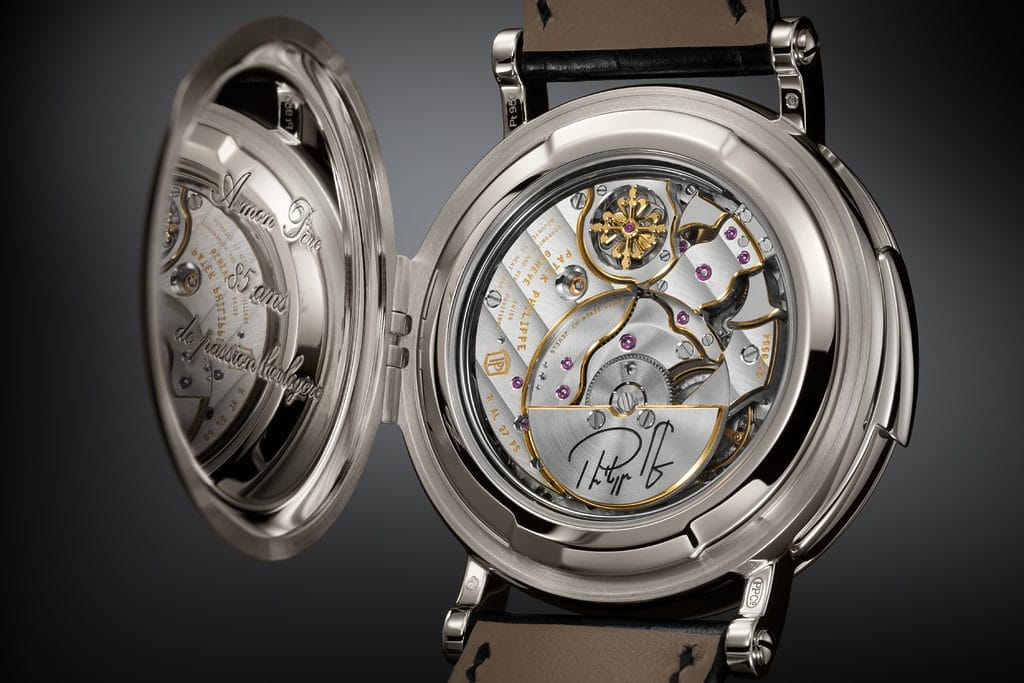
Efforts are focused on increasing power reserve (up to five days and beyond), improving resistance to magnetism, reducing wear through new materials, and developing ever more creative complications: accessible perpetual calendars, astronomical displays, big date indications, poetic moon phases, and more.
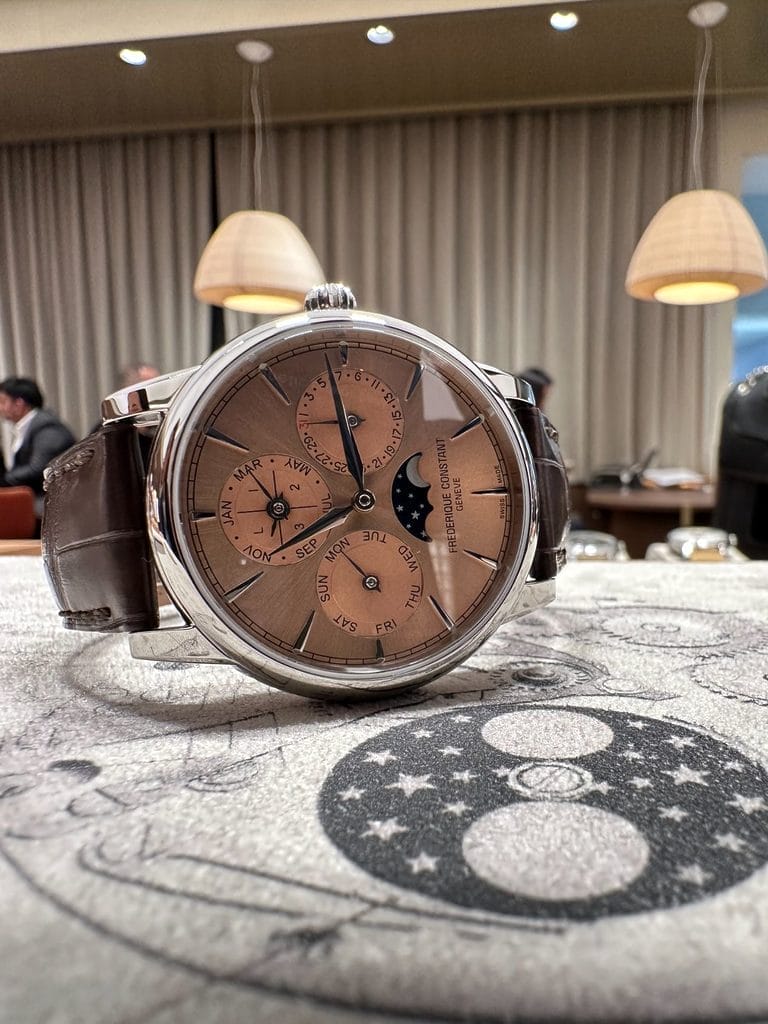
A modern automatic watch thus stands at the crossroads of tradition and innovation, aesthetic pleasure and cutting-edge engineering.
Frequently asked questions
An automatic watch stores energy in a mainspring coiled inside a barrel. A rotor, spun by the natural motion of the wrist, winds this spring through a system of reduction wheels and pawls. The gear train then transmits the spring’s energy to the hands, while the escapement and balance wheel regulate its release at a steady frequency, so the watch keeps accurate time without ever needing a battery.
The rotor is a half-moon-shaped oscillating weight that pivots freely on its axis every time the wrist moves. Its motion drives a train of wheels and pawls that progressively winds the mainspring, either in one direction or in both depending on the caliber, and a clutch mechanism stops it from over-tensioning the spring once it’s fully wound.
Most contemporary automatic watches offer between 38 and 72 hours of power reserve, meaning the time the watch will keep running once fully wound and left unworn. Some modern calibers push well beyond that, reaching five days or more thanks to larger barrels and improved efficiency.
Automatic and manual watches are both purely mechanical: the difference is that an automatic movement winds itself via a rotor, while a manual movement must be wound by hand through the crown each day. A quartz watch, by contrast, relies on a battery and an oscillating quartz crystal for timekeeping, which is generally more accurate but lacks the mechanical craftsmanship and battery-free operation of the other two.
Yes: an automatic watch relies on wrist motion to stay wound, so if it sits unworn for more than a day or two, it will run down its power reserve and stop, at which point a manual wind via the crown is recommended to get it running again. For watches worn only occasionally, especially those with complications like perpetual calendars that are tedious to reset, a watch winder keeps the mainspring wound and the movement running so the watch is always ready to wear.

Leave a Reply